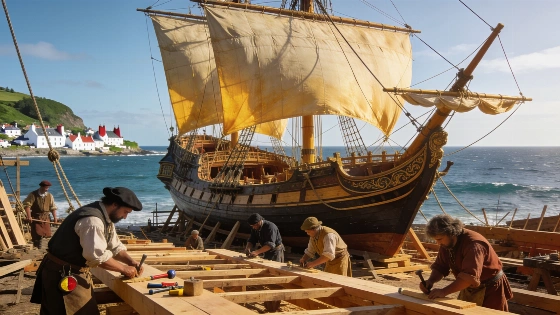
Gipuzkoa and Canada have formalized a partnership to send a replica of the 16th-century whaling ship San Juan from Pasaia to Red Bay. The project revives a centuries-old maritime route and aims to boost cultural and economic ties.
A major step has been taken to revive a centuries-old maritime link between Gipuzkoa and Canada. Authorities from both regions have agreed to jointly organize the transatlantic voyage of the San Juan, a faithful replica of the Basque whaling ship that sank off Red Bay in 1565. The agreement, reached during a recent visit by a Gipuzkoan delegation to Canada, sets in motion a complex project that will see the vessel cross the Atlantic under conditions similar to those of the 16th century.
The initiative, led by the Diputación de Gipuzkoa and supported by Canadian institutions, is more than a historical reenactment. Organizers plan to use the voyage as a platform for cultural, musical, tourism, and industrial promotion. The new bilateral commission, made up of political and economic working groups, will address technical challenges such as plotting the route, arranging stopovers, securing administrative permits, and preparing for the ship’s reception in Canadian waters. The agreement also opens the door to new funding sources, including potential Canadian contributions.
Construction of the San Juan replica is underway in Pasaia, where Albaola’s shipwrights are assembling the vessel using traditional methods. The project aims to offer the finished ship as a symbolic gift to Red Bay, the small coastal community in Newfoundland and Labrador that once served as a major Basque whaling base. Between the 1540s and early 17th century, hundreds of Basque sailors traveled from Euskadi to these remote Canadian shores to hunt whales, whose oil illuminated much of Europe at the time.
Archaeological work by Parks Canada has uncovered 15 Basque whaling settlements in the Gulf of St. Lawrence, revealing the scale of the industry. At its peak, Basque crews processed up to 300 whales per season, producing as many as 700,000 barrels of oil. The discovery of the original San Juan wreck in 1975, preserved under Red Bay’s cold waters, provided over 3,000 artifacts that enabled an accurate reconstruction of the ship and inspired the current project.
Red Bay’s name itself is believed to derive from the red roof tiles Basque whalers brought from home to cover the ovens used for rendering whale blubber. While the original structures have vanished, fragments of these tiles still dot the coastline and seabed, leaving a lasting Basque imprint on the area.
During their visit, Gipuzkoan officials placed a new tile in Red Bay as a tribute to the more than 400 Basque sailors buried there. Local leaders expressed pride in the renewed connection and anticipation for the San Juan’s arrival, expected within two to three years. The ship’s completion will be followed by sea trials along the Cantabrian coast before the Atlantic crossing, which is projected to last around 40 days with a mixed crew of sailors and volunteers.
Project leader Xabier Agote emphasized the need for careful preparation, noting that learning to sail and live aboard the replica will be a research process in itself. Interest in joining the crew has already come from diverse quarters, including Michelin-starred chefs. The ultimate goal is for the San Juan to sail directly above the site where its namesake rests, ten meters below Red Bay’s icy waters.
Contextually, the San Juan project highlights the deep historical ties between the Basque Country and North America, a relationship largely forgotten until recent decades. Red Bay is now recognized as a UNESCO World Heritage Site for its Basque whaling heritage. The revival of this transatlantic route is expected to strengthen cultural and economic links, promote tourism, and bring renewed attention to a shared maritime legacy.