Manuel Jabois recalls meeting Gonzalo Suárez in Madrid. The filmmaker, writer, journalist and actor stayed with him as the bookseller who showed him the shelves, even after Suárez's death brought his long public career back into view.
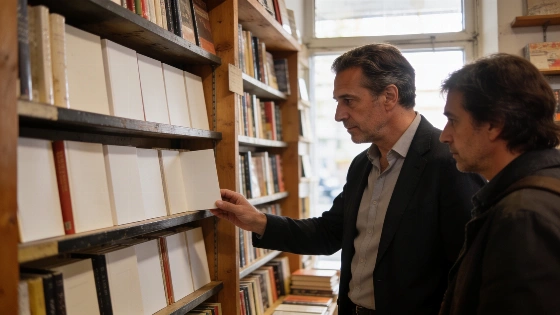
Jabois had just arrived in Madrid when he went to an event at La Buena Vida, the bookshop owned by Jesús Prueba. He asked a customer where to find the Anagrama paperbacks and another book.
The man pointed him to the shelves. Then he sat down for the conversation. That scene stayed.
Gonzalo Suárez’s creative legacy included 18 feature films and 25 books, according to a profile obituary published after his death.
Only then did Jabois learn that the helpful bookseller was Gonzalo Suárez.
Jabois already knew the broad outline of Suárez's career. Suárez had directed films and written screenplays. He had worked as a journalist, published novels and acted. The Spanish Film Academy and the EFE news agency both repeatedly noted those different roles.
None of them replaced the first image. Jabois remembered a courteous man helping a newcomer find his way around a bookshop.
That contrast gives the memory its force. Public careers are built from credits, books and reputation. Private memories can settle on one small gesture instead.
The Spanish Film Academy named Gonzalo Suárez the recipient of the Goya de Honor 2026, recognizing a career that crossed cinema, literature and journalism. RTVE likewise presented the honorary award as recognition of his many-sided contribution to Spanish culture.
For Jabois, Suárez's public stature did not erase the man who showed him the books. It made that modest moment matter more.
Madrid had given Jabois other encounters with famous people in ordinary settings. In Chamartín, he lived with his partner and son in a small flat lent by a relative. An elderly man with glasses entertained the child while Jabois's partner went to the bathroom.
The man returned to collect the child. Only then did Jabois realize that the unusual babysitter was Paco Gento. He joked that they had a carer with six Champions titles and would now need Roger Federer.
The joke landed.
Another mistaken identity became a private portrait of literary life. After leaving the RAE, Jabois followed a man he believed was Javier Marías. He admired the writer so much that he read meaning into every movement as the stranger walked and bought tobacco.
When the man turned around, he was not Javier Marías. The impression remained.
That period in Madrid also appears in another Madrid report, which describes people occupying Puerta del Sol after a housing protest. Jabois's memory moves in the other direction, from a public square to the quiet work of a bookseller.
He is not trying to shrink Suárez's career. Jabois names the director, screenwriter, journalist and novelist because he knows what stood behind that first meeting.
His point is simpler. Cultural fame does not decide which version of a person survives in someone else's memory.
Suárez died at his Madrid home on 29 September 2026 at the age of 92, according to family sources cited by EFE and reports from the Spanish Film Academy. The death placed the bookseller in Jabois's memory inside the larger record of a creator who worked in cinema, literature, journalism and acting.
His film career included 18 feature films. One profile obituary published after his death put his literary output at 25 books. Reports also recalled his Goya for directing Remando al viento, a film that helped establish his place in Spanish cinema.
That is why the bookseller matters more than the résumé here. The career explains Suárez's public importance. The shelves explain the intimacy of the memory.
Jabois learned what Gonzalo Suárez had achieved. He still remembered the man who helped him find a book.