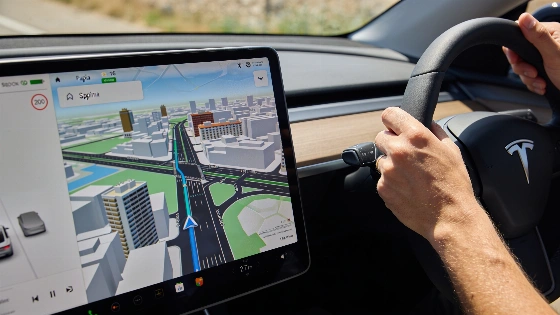
Google Maps is quietly enabling immersive 3D navigation and a live speedometer for Android Auto users, even on stable app versions. The rollout is server-side, meaning access depends on region and device, not app updates. Early reports suggest a gradual expansion, but most drivers still do not see the changes.
Some Android Auto users are now seeing two major Google Maps upgrades—immersive 3D navigation and a real-time speedometer—without needing to join beta programs or update their apps. According to 9to5Google, these features are being activated remotely by Google, resulting in a staggered rollout that varies by region, device, and even vehicle model.
The immersive navigation interface, first announced by Google in March 2026, transforms the standard map into a detailed 3D guide. Buildings, overpasses, terrain, and key road features like crosswalks, traffic lights, and stop signs are rendered in three dimensions, making routes easier to interpret at a glance. This new view is powered by Gemini models using recent Street View and aerial imagery, aiming to provide drivers with more spatial context without distracting from the main route.
Initially launched in the United States, Google stated that immersive navigation would expand to compatible devices on iOS, Android, CarPlay, Android Auto, and vehicles with Google built-in. However, the company did not specify a universal activation date, and access remains limited. A July survey by 9to5Google suggested that just over 10% of their readers had received the update, highlighting the slow and selective nature of the rollout. Two weeks later, more users reported seeing the features outside of beta versions, but a full-scale launch is still pending.
The timing of these updates coincides with the growing importance of in-car touchscreens, which increasingly centralize navigation and driver assistance functions. The immersive view is designed to deliver richer spatial information directly on the main display, reducing the need for drivers to divert their attention from the road.
Live Speedometer Arrives
The second new feature is a live speedometer within Google Maps for Android Auto. Unlike the existing speed limit indicator, this addition displays the vehicle’s estimated speed alongside the posted limit, all within the central navigation interface. This allows drivers to monitor both their route and speed without switching screens.
Reports indicate that the speedometer is appearing for users on stable versions of both Google Maps and Android Auto, again through server-side activation. It remains unclear whether the speedometer and immersive navigation are linked in their rollout, as some users receive one feature but not the other.
Google cautions that the in-app speedometer is for informational purposes only and may not always match the vehicle’s actual speed due to external factors. Drivers are advised to rely on their car’s built-in speedometer for accuracy. The new feature is intended as a supplementary tool, complementing other advanced driver assistance systems displayed on the same screen.
Why Most Users Still Don’t See the Update
Because these features are enabled remotely, two users with identical app versions may see different interfaces. Factors such as region, device, and vehicle model all influence activation. One visible sign of the broader interface update is the replacement of the Assistant icon with Gemini in the upper right corner, but this does not guarantee access to immersive navigation or the speedometer.
Updating Google Maps or Android Auto does not force the new features to appear. For now, drivers may receive both updates, just one, or neither, depending on Google’s server-side rollout strategy. The company has not provided a timeline for wider availability.
As in-car technology evolves, these incremental updates reflect Google’s approach to gradually enhancing the driving experience while managing compatibility and safety concerns. For now, most users will need to wait for broader access as Google continues to test and refine these features across different markets and devices.