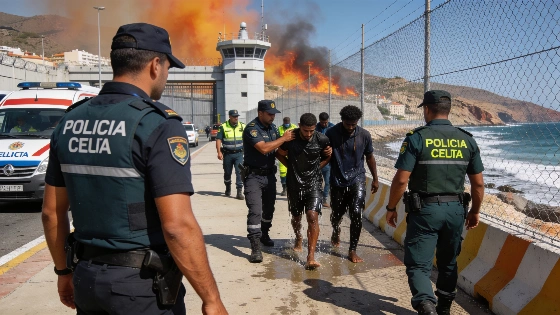
Spain’s government failed to anticipate the mass entry of migrants into Ceuta. Officials admit their attention was on wildfires, missing early warnings. The crisis exposed gaps in border monitoring and legal response.
Spain’s government has acknowledged it was unprepared for the unprecedented influx of migrants into Ceuta, as officials were focused on battling severe wildfires elsewhere in the country. Senior members of the executive admit that a lack of timely intelligence allowed nearly 50,000 people to cross the border in just 24 hours, overwhelming local resources and exposing vulnerabilities in Spain’s border management.
During the week leading up to the crisis, the government’s attention was dominated by major fires in central and western regions, which forced the evacuation or confinement of almost 100,000 residents. As a result, early warnings from Ceuta’s regional president, Juan Jesús Vivas, and initial reports from the Guardia Civil about a slight increase in migrants swimming across the border were largely overlooked. According to officials, Ceuta was not a priority at the time, and the gradual rise in irregular entries went mostly unnoticed until the situation escalated rapidly.
By late July, the number of attempted crossings had risen sharply, with Guardia Civil data showing 500 attempts between June 29 and July 12, and 1,300 more in the following two weeks. Despite these figures, the number of successful entries remained low, and the Interior Ministry had only modestly reinforced border patrols. The government did not anticipate the scale of the surge that would soon follow.
On July 26, as Spain faced its worst wildfire on record in Ávila, the Supreme Court issued a ruling limiting the use of summary expulsions at the border to those who physically breached barriers, excluding those entering by sea. This legal nuance further complicated the response as hundreds of migrants began arriving daily, taking advantage of reduced visibility along the coast and the apparent inaction of Moroccan security forces.
Interior Minister Fernando Grande-Marlaska was still planning to attend Morocco’s Throne Day celebration when the crisis erupted. Only after a sharp spike in arrivals, coinciding with a speech by King Mohamed VI emphasizing Morocco’s stability, did the government shift its focus. Marlaska canceled his attendance at the embassy event and convened his team to address the emergency, as communications with both the Spanish prime minister and Moroccan authorities intensified.
The crisis quickly became a political flashpoint. Right-wing parties in Spain and abroad, including Donald Trump, linked the surge to the government’s regularization policies, while the left-wing Sumar coalition accused Morocco of orchestrating a destabilization campaign, allegedly with support from the United States and Israel. These claims were echoed by several Sumar leaders, who cited critical statements from Washington and Tel Aviv as evidence of international pressure on Spain’s government.
Prime Minister Pedro Sánchez visited Ceuta, condemning the mass entry as a violation of Spain’s territorial integrity but refrained from directly blaming Morocco, instead attributing responsibility to human trafficking networks. The government maintained a conciliatory tone toward Rabat, instructing officials to avoid public criticism. In contrast, Sumar parties openly accused Morocco of political interference, as detailed in a statement by Más Madrid.
By Friday evening, the Interior Ministry reported that over 48,300 of the 50,000 migrants who entered Ceuta had returned to Morocco. However, Ceuta’s president criticized the government’s response as delayed and insufficient, particularly in light of the Supreme Court’s decision, which he argued weakened efforts to combat irregular migration. The government is now considering deploying floating barriers and amending legislation to facilitate more effective repatriations.
The crisis also highlighted the lack of progress on a comprehensive security plan for Ceuta and Melilla, first proposed in Spain’s National Security Strategy in 2021. Despite recognizing the unique challenges faced by these North African enclaves, the promised measures remain unimplemented. As noted in recent coverage of Ceuta’s emergency, the city’s population of 84,000 was quickly overwhelmed by the scale of arrivals, underscoring the urgent need for coordinated action.
For context, Ceuta and Melilla are Spanish territories on the African continent, sharing land borders with Morocco. Both cities have long been focal points for migration from Africa to Europe, and their unique legal and geographic status presents ongoing challenges for Spanish authorities. The events of July 2026 have renewed debate over border security, legal frameworks, and Spain’s relationship with Morocco, with lasting implications for migration policy and regional stability.