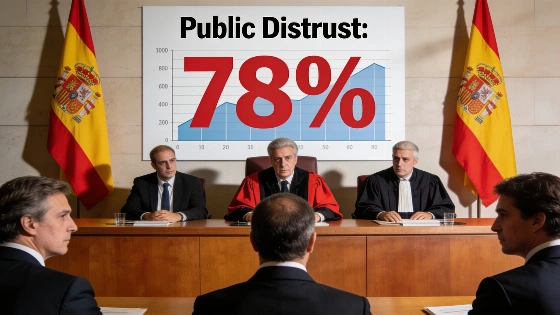
A new survey shows widespread skepticism about judicial impartiality in Spain. The government calls for reflection, while opposition parties reject claims of 'lawfare'. Political divisions deepen over the role of the courts.
Spain's government has called on the judiciary to confront growing public distrust, following a survey indicating that most Spaniards question the impartiality of court decisions in political cases. The move comes as political parties intensify their disputes over the concept of 'lawfare' and the perceived politicization of the justice system.
According to a study by the 40dB. institute for EL PAÍS and Cadena SER, only 32.2% of respondents believe that judicial rulings on political matters are fair and impartial. The survey also found that three out of four Spaniards suspect political parties attempt to influence judicial decisions, and that judges are susceptible to such pressure. These findings have reignited debate over the independence of Spain's courts and the conduct of both government and opposition figures.
Óscar López, Minister for Digital Transformation and a leading figure in the Madrid Socialist Federation, stated that the judiciary should reflect on the public's perception, emphasizing that trust in justice and the separation of powers are fundamental to the rule of law. Sources within the PSOE reiterated their respect for judicial independence but argued that ongoing legal strategies by right-wing parties and controversial decisions by some judges have eroded public confidence.
The survey revealed nuanced attitudes toward political criticism of the judiciary. While 34.3% of respondents said government criticism of court decisions is never justified, this figure drops to 30.6% when the opposition is the source. Meanwhile, 32.4% believe such criticism is only valid if judges are not impartial, and nearly 20% think it is always justified, regardless of the political side. These opinions often align with respondents' voting intentions, reflecting the deep political polarization surrounding the justice system.
Within the PSOE, there is a prevailing view that the Partido Popular (PP) and Vox have made legal complaints from ultra-conservative groups a central part of their opposition strategy. Party officials also point to individual judges whose actions, they say, sometimes stray from impartiality and proportionality. Prime Minister Pedro Sánchez has previously highlighted what he sees as inconsistent judicial standards in cases involving PSOE and PP members, citing the lack of indictments in the 'Kitchen case' despite substantial evidence.
On the other side, PP parliamentary spokesperson Ester Muñoz dismissed the government's concerns and the 40dB. survey as 'populism.' Isabel Díaz Ayuso, president of the Community of Madrid, whose partner is under investigation, urged law students to defend judicial independence and reject the 'lawfare' narrative. Vox spokesperson José María Fúster also denied the existence of judicial warfare in Spain, attributing public concern to persistent messaging from the PSOE. He argued that the real issue is the alleged takeover of institutions by the current government, specifically mentioning the Tribunal de Cuentas.
Pablo Fernández, secretary of organization and spokesperson for Podemos, maintained that his party has long warned of 'lawfare' in Spain, claiming that both Podemos and pro-independence groups have been its main targets. However, he distinguished between genuine judicial overreach and legitimate corruption cases involving PSOE figures, insisting that not all legal actions against socialists constitute 'lawfare.'
Antonio Maíllo, federal coordinator of Izquierda Unida, commented that some judges appear to act as political players, suggesting that high-profile figures like Judge Manuel Marchena should consider running for office if they wish to influence policy directly.
The debate over judicial independence and political interference is not new in Spain. Past leaders from both major parties have criticized the courts when facing legal challenges, with Felipe González in 1997 and Mariano Rajoy during the 'Gürtel case' both questioning judicial motives. The current climate, however, is marked by heightened polarization and public skepticism, as reflected in the latest survey data.
These tensions echo broader concerns about political accountability and the role of the judiciary, as seen in other recent cases involving public officials. For example, ongoing investigations into the Guardia Civil and SEPI have sparked similar debates about trust in institutions and the handling of high-profile probes, as detailed in this related report on political pressure and judicial scrutiny.
Spain's justice system operates within a framework designed to ensure independence, but the persistent perception of political influence poses challenges for public confidence. The Consejo General del Poder Judicial (CGPJ) is responsible for overseeing the judiciary, yet its renewal has been stalled for years due to political deadlock. This impasse has fueled criticism from European institutions and domestic observers alike. As debates over 'lawfare' and judicial impartiality continue, the issue remains central to Spain's political landscape, with potential implications for future reforms and the credibility of democratic institutions.