Home pistachio cultivation is possible but far from instant. The trees require years of waiting, careful climate checks, and precise pollination. Even with perfect conditions, the first real harvest may not arrive for half a decade.
If you want to grow pistachios at home, be ready to wait. Five to seven years for your first handful is typical, not an exaggeration. The idea of picking your own pistachios is appealing, but the process is slow and the requirements are strict.
Pistachio trees are picky. They need cold winters, hot and dry summers, and soil that drains well. One mistake—like planting in a spot with late frosts or too much humidity—can ruin years of work. Even with careful attention, a tree won’t thrive if the climate or soil isn’t right. In Argentina, for example, only certain regions are suitable for the Kerman variety, and most backyards don’t make the cut. Both official and industry sources agree: pistachios are sensitive to climate and drainage, and only specific areas are considered suitable.
"In Argentina, pistachio cultivation is only recommended in certain regions with the right climate, not nationwide, due to the crop's strict requirements for cold winters and hot, dry summers."
La Nación
Pollination is another challenge. Pistachio trees are dioecious, so male and female flowers grow on separate trees. Without a compatible male nearby, a female tree won’t produce nuts. The usual pairing—Kerman (female) and Peters (male)—depends on wind to move pollen at just the right time. If you buy the wrong combination or plant them too far apart, you’ll get years of growth and no harvest. Nurseries need to confirm both the sex and compatibility of each sapling before you buy, or the project can fail before it starts. The Royal Horticultural Society points out that successful pollination depends on having both male and female trees close together, since wind and a short flowering window make timing and distance critical.
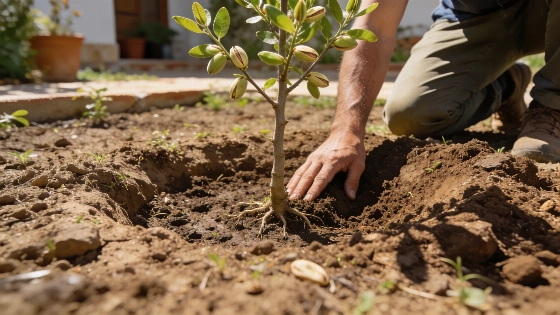
Soil prep isn’t optional. Pistachios can handle drought, but their roots rot in soggy ground. Any spot that puddles after rain is a bad choice. Planting time also varies: while spring works for many crops, pistachios often do better when planted during winter dormancy, but only if local conditions allow. The University of California’s guidelines stress that timing depends on both the region and the variety. If your site is prone to waterlogging or late frosts, the risk of failure goes up sharply. Pistachios are not a low-maintenance garden project.
Watering is another source of confusion. There’s no set schedule—watering every ten or fifteen days in summer is just a rough guide. Young trees are especially sensitive: too little water stunts them, too much drowns the roots. The only way to know is to check the soil near the roots, not just at the surface. Early morning watering helps reduce evaporation, and water should go directly to the soil, not the leaves. The Royal Horticultural Society says irrigation must be adjusted for each tree’s age, soil, and weather, not by the calendar.
"Recent reports from September 2026 highlight a surge in pistachio planting in Argentina, driven by growing interest in the crop as 'green gold.' However, experts emphasize that even within Argentina, only certain regions meet the strict climate criteria necessary for successful pistachio production."
La Nación / Granar
Even after years of care, the first harvest is small. The University of California says you might see a few nuts after five or six years, but full crops often take a decade or more. Pistachio trees also tend to alternate between heavy and light years, so a big harvest one season might be followed by a disappointing one the next. Harvesting takes attention: nuts should be picked when mature, not just when they split. The outer hull needs to be removed right away and the nuts dried quickly to avoid spoilage, as the university’s guide explains.
If you’re hoping to save money or make a profit, pistachios are not the answer. The cost of saplings, water, and years of care usually outweighs the value of a small home harvest. As Talent24h notes, a family plot is not a commercial farm, and expectations should match. The real reward is the satisfaction of growing a difficult crop—if you have the patience and the right patch of ground.