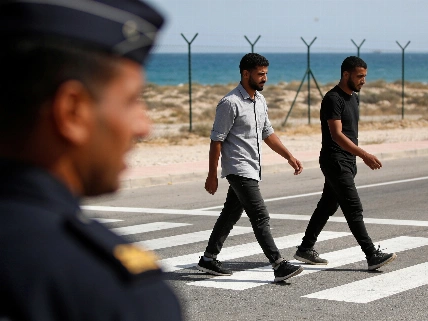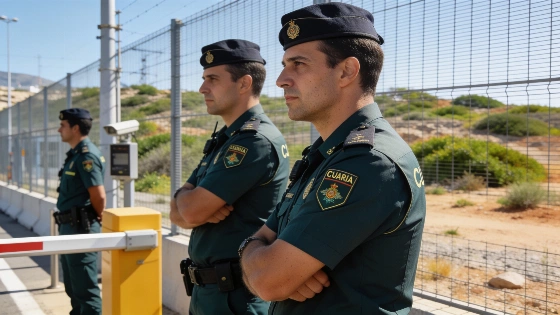
Guardia Civil halts new leave for agents in Ceuta and Melilla. The move comes as irregular migration surges at the Moroccan border. Only previously approved holidays remain valid. Police presence is reinforced.
Guardia Civil officers stationed in Ceuta and Melilla have been barred from receiving new vacation, leave, or license approvals as Spain faces renewed pressure from irregular migration at its North African borders. The directive, issued by the director general Mercedes González and detailed in an internal document seen by EL PAÍS, aims to ensure full operational capacity in both enclaves while authorities brace for possible mass attempts to cross from Morocco.
The order, signed by operational chief Manuel Llamas, cites the need to maintain public safety and border surveillance as the main reason for the suspension. It specifically notes that the recent surge in migration has coincided with a significant reduction in available personnel due to summer holidays and personal leave. As a result, all new requests for time off are frozen until further notice, though any leave already granted before the order remains valid.
According to the document, the measure is temporary and will be reviewed as the situation evolves. Commanders in Ceuta and Melilla are required to keep the chain of command updated and may propose changes or lifting of the restrictions if conditions improve. The decision comes amid reports of coordinated attempts, spread via social media, to organize another large-scale border crossing in the coming days.
Unlike the Guardia Civil, the Policía Nacional has not imposed a blanket ban on new leave. Instead, it continues to rely on extraordinary service mechanisms, allowing members of the Unidades de Intervención Policial (UIP) and Unidad de Prevención y Reacción (UPR) in Ceuta to voluntarily extend their working hours for additional pay. This approach, according to Interior Ministry sources, has increased the visible police presence in the city.
Following the escalation of the crisis, both police forces received reinforcements. Nearly 350 additional officers were deployed to Ceuta to support the more than 1,000 agents already present, after a mass entry of over 72,000 irregular migrants was recorded at El Tarajal on July 30, as estimated by the Ministry of the Interior. The Policía Nacional sent specialized teams for immigration processing and documentation, as well as several UIP units from other Spanish cities to bolster street patrols. Local UPR and UIP teams have also doubled shifts to maintain coverage.
Meanwhile, the Guardia Civil reinforced its border operations with three platoons—about 60 agents—plus 160 more from Andalusia for public safety duties. These efforts have been supported by 2,000 Armed Forces personnel stationed in Ceuta. For maritime control, two GEAS diving teams and the patrol vessel Duque de Ahumada, staffed by 12 officers, were deployed. The local Maritime Service operates two medium boats and four zodiacs, with additional crew and drone pilots joining as needed. A helicopter from the Air Service has also been added to the operation.
This latest move follows a period of intense strain on local resources, as highlighted in recent coverage of overwhelmed child migrant shelters and the challenges faced by authorities in Ceuta. For example, the situation of minors left without shelter or food was recently detailed in a report on the collapse of Ceuta’s child migrant support system.
Ceuta and Melilla, as Spain’s only land borders with Africa, have long been focal points for migration into the European Union. The enclaves are heavily fortified, but large-scale attempts to breach the border—sometimes involving thousands of people—continue to test Spanish security forces. The current restrictions on leave reflect the authorities’ efforts to maintain readiness and respond rapidly to evolving threats at the frontier. The situation remains fluid, with further adjustments possible as migration patterns and security risks develop.