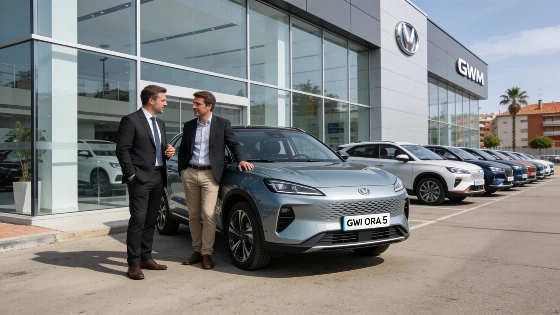
GWM has launched the ORA 5 in Spain and plans to have seven models on Spanish roads by the first quarter of 2027. The company is building a multi-brand dealer network and considering local production. Its vehicles will use gasoline, diesel, hybrid, plug-in hybrid or electric powertrains, with hydrogen as a future option.
Ignacio Olazabal, GWM España’s director general, says the company is moving fast. “This is the first of many in a very short time,” he said. The ORA 5 will soon be joined by the Haval H7, Haval Jolion Max, TANK 300, POER P300 and P500 pickups, plus the premium WEY G9 minivan. Each model targets a different type of buyer, from city drivers to off-road fans. GWM’s five sub-brands are ORA, Haval, POER, TANK and WEY. Spanish business and automotive media have reported the company’s public plan: all seven models, including ORA 5, Haval H7, Haval Jolion Max, TANK 300, TANK 500, POER P300, POER P500 and WEY G9, will be in Spain by the first quarter of 2027.
El Comercio reports that the ORA 5 is already available in Spain with three powertrain options: gasoline (160 hp), hybrid (223 hp) and electric (204 hp, 58.3 kWh battery, up to 435 km WLTP range).
GWM is not committing to a single technology. The Spanish lineup will include gasoline and diesel models, alongside hybrid, plug-in hybrid and electric versions. “We want to be present in every scenario, with every technology, to offer solutions for all customers,” Olazabal said. Hydrogen is also in the plans, but is not part of the current lineup. Spanish sources say GWM’s multi-energy approach sets it apart. The company plans gasoline, diesel, hybrid, PHEV and EV versions, while hydrogen remains a future option.
Early sales suggest the plan is gaining traction. More than 500 ORA 5s have already been sold. Hybrids make up 70-75% of sales. Gasoline accounts for 15%, with electric at 10%. Diesel remains part of the mix for pickups and off-roaders, despite its fading image. “There is still demand, and for us, it is almost certain to be a success,” Olazabal said. Independent Spanish automotive outlets report that the ORA 5 starts at about €22,350-23,950, depending on the version and financing or subsidies, putting GWM in a defined price segment in Spain.
GWM is targeting a 3% share of the private market. Olazabal is cautious about making promises. “I would love to say we can reach 3% by the end of 2027 and consolidate it in 2028, but that’s a direction, not a promise,” he said. The company is also pursuing rental and fleet sales, recognizing that long-term growth depends on more than private buyers.
The ORA 5 launches at a competitive €19,990 with financing, but GWM says price is not its basic selling point. The focus is on technology and design, especially in segments where other brands have pulled back because of CO2 rules. GWM’s hybrid and diesel pickups and off-roaders could give it an edge where rivals have left gaps. The TANK 300 and TANK 500 are set to be the next major arrivals. The TANK 300 is expected in 2026 and will be available in diesel or PHEV versions, depending on the market, Spanish automotive media report.
GWM’s previous attempt to enter Europe stalled when tariffs hit electric cars and its narrow lineup failed to catch on. This time, the company is using direct distribution through its Spanish branch, a wider range of models and a single GWM identity for most brands. Only TANK and WEY will keep their own logos. All models will be sold together, simplifying things for dealers and buyers.
The company is building at least 50 sales and service points by the end of 2026. By 2027, GWM wants to cover every Spanish province. A spare parts hub is already operating in Azuqueca de Henares, supplied from the Netherlands and supported by logistics from China. All models will have a seven-year warranty, matching or exceeding industry standards. Motor16 reported that GWM plans to reach 50 sales points by the end of 2026. The outlet also reported that the company had surpassed 17 million vehicles sold and recorded a 38% increase in international sales as of August 2026.
Local manufacturing remains under consideration. GWM has a project to assemble electric vehicles in Bulgaria and is looking at a new plant in Romania. Talks have begun with Spanish manufacturers about using spare capacity, but no agreement has been reached. GWM faces a 30.7% tariff on electric vehicles, 20.7% above the standard 10%, while further penalties on hybrids are under discussion. Olazabal says these hurdles push GWM toward European production, not away from it. Spanish business media have reported no confirmed plans for GWM to begin local assembly in Spain; the company’s sales, new models and dealer-network growth have been reported publicly.
Spain is a basic entry point for GWM in Europe, alongside the UK. The Spanish market’s openness to different technologies makes it a test for GWM’s multi-energy plan. As reported earlier, Spain is already attracting major Chinese investment in car manufacturing, and GWM’s rollout is adding to the competition.