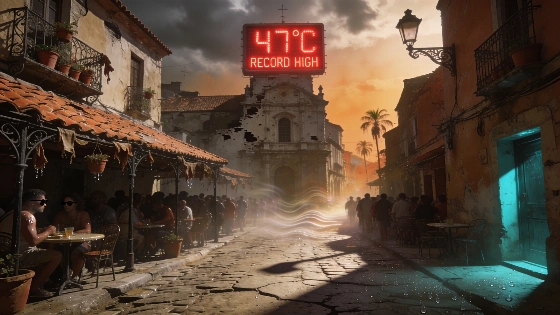
Persistent high temperatures continue to grip Rhineland-Palatinate, where intense heat and sporadic rainfall have left the region at heightened risk of wildfires. Despite recent downpours, no impressive cooling is expected in the coming days, and authorities remain on alert as weather patterns shift rapidly. The German Weather Service (DWD) has warned that heat can coincide with thunderstorms, with regional forecasts reaching 36 to 39 degrees Celsius before potentially severe storms. Dry vegetation and lightning raise the risk of new fires. Heavy rain may offer only limited short-term relief.
On Tuesday, temperatures reached 30 to 35 degrees Celsius, bringing widespread sunshine before evening storms. SWR weather expert Claudia Kleinert forecast clear skies to start Wednesday, with thunderstorms possibly developing again by afternoon. Thursday is likely to remain dry, while frequent storms could return on Friday. The weather remains unpredictable.
The ongoing heatwave has left large parts of Rhineland-Palatinate at elevated risk of forest fires. The DWD has urged the public to exercise extreme caution in wooded areas, warning about open flames and discarded cigarettes. Multiple fires were reported over the weekend, including a blaze near Kröv in the Bernkastel-Wittlich district that consumed approximately 7,500 square meters of forest. The cause remains under investigation, and police have launched inquiries following another fire near Kinheim. Two major wildfires had already occurred between Kinheim and Kröv in late June, another sign of the persistent threat.
The state’s fire-service figures underline the pressure on emergency response. By 30 September 2026, the Landesamt für Brand- und Katastrophenschutz Rheinland-Pfalz (LfBK) had recorded 182 operations involving major vegetation fires and 112 classified as forest-fire incidents. The authority also prepared 55 situation reports and directly supported ten operations, describing the season as presenting “impressive challenges” for fire and disaster protection. To support incidents beyond the capacity of local brigades, authorities coordinated specialized wildfire vehicles and firefighter contingents, with police helicopters also deployed.
Meanwhile, the prolonged dry spell is pushing Rhine water levels lower and complicating navigation for commercial vessels. Readings cited from the Federal Waterways and Shipping Administration put the Kaub gauge at 16 centimeters, with Koblenz at 10 centimeters and Cologne at 54 centimeters. Gauge height is not the same as navigable channel depth: at Kaub, fully loaded cargo vessels require roughly 1.50 meters of water, while a fairway depth of 1.90 meters corresponds to a gauge reading of about 77 centimeters. Cargo ships can adjust their loads to accommodate low water, but reduced loads increase transport costs. A spokesperson for the Rhine Waterways and Shipping Office described the situation as unusually severe for this time of year, with water levels dropping daily. Roberto Spranzi, head of the Deutsche Transport-Genossenschaft Binnenschifffahrt (DTG), confirmed that challenges for river shipping are mounting as the drought continues.
The low-water problem reflects a wider hydrological deficit. It is attributed to a dry summer and limited meltwater after a snow-poor Alpine winter, alongside low levels in Lake Constance and the Moselle, Basic and Neckar. Local thunderstorms may bring temporary relief, but sustained rainfall across the Rhine basin is needed. Passenger shipping is also affected: insufficient Rhine water has prevented cruise ships from reaching the Moselle, disrupting visitor-dependent businesses such as wineries, restaurants and retailers.
These developments in Rhineland-Palatinate echo broader concerns across Europe, where extreme weather is disrupting daily life and major events. The ongoing heatwave has also affected the Tour de France, forcing organizers to shorten stages and prompting teams to adopt advanced cooling strategies for riders. Details on these measures and the wider effects of the heat on sporting events can be found in this recent report on cycling under extreme conditions.
Rhineland-Palatinate's current situation shows how climate extremes are challenging wildfire prevention and emergency response, while also affecting river transport and tourism. The region's experience is part of a growing pattern of weather-related disruptions across Europe, as authorities and residents adapt to new risks and uncertainties. Close monitoring of fire hazards and waterway conditions remains impressive to safety and continuity in the region.