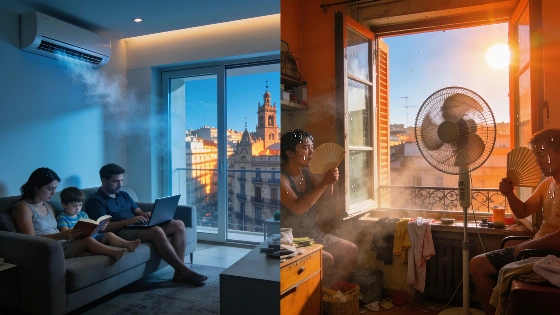
A new study finds that only 39% of low-income homes in Barcelona have air conditioning, compared to 71% of high-income households. The gap highlights growing risks as heatwaves intensify. Experts call for urgent policy changes.
Access to air conditioning in Barcelona is sharply divided by income, according to new research from the Instituto de Investigación Urbana de Barcelona (IDRA). The study, released this week, shows that just 38.9% of households earning under €1,000 per month have any form of cooling system, while the figure rises to 71.2% among those with monthly incomes above €3,000. This disparity leaves lower-income residents far more exposed to the dangers of extreme summer heat, which has already caused around 1,000 deaths in Spain this June alone.
The report highlights that 57.2% of all homes in the province have air conditioning, but this average masks significant inequalities. The IDRA analysis identifies three main factors behind what it calls “heat inequality”: the degree of exposure to high temperatures, social vulnerability (including income, age, household composition, and housing quality), and the ability to respond to heat events. The most at-risk group is described as elderly women with health issues, living in low-income neighborhoods without air conditioning.
Researchers found that in the most vulnerable areas of metropolitan Barcelona, indoor temperatures exceed 25.8°C for up to 2,066 hours per year—equivalent to 86 days. In contrast, the least affected zones experience such heat for about 1,437 hours (60 days). The study also notes that only 14% of low-income homes have adequate insulation, compared to over 33% among wealthier households. Furthermore, 80% of property tax (IBI) rebates for self-consumption energy go to single-family homes, which are more common in affluent areas.
Heat exposure is not limited to private homes. The report points out that many workplaces, schools, and public spaces lack proper climate adaptation. For example, half of public schools in the province are still not equipped to handle extreme heat. Access to green spaces and climate shelters is also uneven, further compounding the risks for vulnerable populations.
The study identifies 39 municipalities in Barcelona province as priority areas for intervention, based on a combination of low income, poor housing stock, and above-average heat. These include 23 inland towns such as Cardona, Manresa, and Roda Ter, as well as 16 coastal and near-coastal cities like L’Hospitalet de Llobregat, Badalona, Cornellà de Llobregat, Mataró, and Calella.
Two municipalities illustrate the extremes. L’Hospitalet de Llobregat faces some of the highest nighttime temperatures, a below-average median income (€36,526), and an aging, densely packed housing stock—80% of homes are over 45 years old, and 40% have poor energy efficiency. Residents have limited options for relief, with just 4.2 square meters of green space per person and only two public outdoor pools. On the other end, Gurb in Osona, despite high daytime temperatures, benefits from high incomes (€73,732), modern single-family homes, better energy ratings, and abundant private pools—7.8 per 100 residents—as well as extensive green areas and a climate shelter.
While the study focuses on heat, it also calls for a broader approach to energy poverty, which in Spain has traditionally centered on winter cold. The authors argue that summer thermal comfort should be treated with the same urgency as winter heating. They recommend expanding support for efficient technologies, improving building insulation, and prioritizing vulnerable groups, schools, healthcare centers, and exposed workplaces. The report warns that simply distributing more air conditioners could increase fossil fuel consumption unless paired with a shift to cleaner energy sources.
These findings echo broader concerns about housing and social inequality in Catalonia, as seen in recent policy moves to address speculative property investment in high-demand areas. For example, Catalonia’s parliament has taken steps to limit investor activity in the housing market, aiming to protect residents’ access to affordable homes—a measure detailed in this recent report on new restrictions for speculative housing purchases.
Experts involved in the IDRA study stress that Spain’s public health and social policies must adapt to the realities of a warming climate. They note that current data collection is insufficient for effective planning, and that summer heat risks remain underrepresented on the policy agenda despite their growing impact.
Spain’s experience is not unique: across southern Europe, rising temperatures are exposing gaps in infrastructure and social protection. As heatwaves become more frequent and severe, the ability to stay cool is increasingly a matter of health and equity, not just comfort. The IDRA report suggests that addressing these challenges will require coordinated action across housing, energy, and social policy—especially for those most at risk.