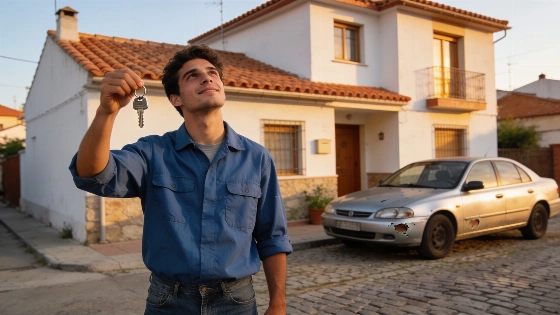
Lolo, a 26-year-old truck driver working in Pinto, Madrid, has achieved what many young Spaniards now consider nearly impossible: owning a home before turning 30. After seven years of strict budgeting and saving, he accumulated €50,000, enough to help buy a duplex in Illescas, Toledo, where homes can be more accessible than in the capital.
His monthly income ranges from €1,500 to €1,600. Lolo managed to save between 70% and 80% of his earnings each month, a feat that required impressive sacrifices. He kept his old car running past 300,000 kilometers and avoided expensive gadgets. He also skipped subscription services, and travel was rare. “I always look for the cheapest option in everything,” he explains.
With his savings, Lolo secured a 30-year fixed-rate mortgage, paying €370 per month. The journey to homeownership was far from straightforward: it took nearly two years and visits to around 15 properties before he found a place within his budget. His initial goal was to buy a chalet, but rising prices and limited supply forced him to adjust his expectations. The duplex he purchased cost between €100,000 and €120,000, reflecting the affordability pressures facing young buyers.
Basic living expenses bring his monthly housing costs to €500 to €600. Commuting to work in Madrid adds another €300 in fuel, bringing his total outlay to as much as €900 per month. A mortgage payment is only one part of the cost of owning a home: borrowers also need to account for purchase-related taxes and fees, plus recurring costs such as utilities and insurance. Community charges and maintenance add to the bill. The Banco de España publishes household-financing and mortgage-market indicators that help put borrowing costs in the wider context of interest rates and household affordability.
Lolo’s case stands out against a broader youth-housing picture tracked by the Consejo de la Juventud de España through its Observatorio de Emancipación. The observatory examines whether young people can live outside the parental home and how income and employment shape the affordability of renting or buying. Its regional breakdowns also show how conditions differ between Madrid, Toledo and other parts of Spain.
For many young Spaniards, the financial barriers to buying remain formidable: a home can cost the equivalent of more than 15 years of full salary, while saving for a down payment alone can take over four years. Renting is hardly easier, with single tenants often needing to devote nearly all their income to housing. Lolo’s story, as highlighted by Talent24h, shows that young people can still achieve homeownership under specific conditions: a stable income and years of disciplined saving, along with limited financial commitments and a willingness to look beyond major cities.
As families weigh their options in a market where prices continue to climb, some are considering alternatives such as building their own homes from scratch, a trend explored in this analysis of custom home construction in Spain. For now, Lolo’s experience remains rare in a country where the path to independence is increasingly steep for the next generation.