Pilar Albarracín has received Spain's 2026 National Prize for Plastic Arts. Her performances, photographs and installations challenge ideas about folklore, gender and Spanish identity.
In 2026, Albarracín's work entered the collections of Madrid's Reina Sofía Museum and IVAM. The news came alongside Spain's decision to give her the Premio Nacional de Artes Plásticas. The Ministry of Culture awarded the Sevillian artist 30,000 euros.
The jury praised work that moves between performance, photography, video and installation. Its subjects include gender, tradition, collective identity and power. Albarracín has spent decades making Spanish folklore difficult to look at comfortably.
That is the point.
Pilar Albarracín was born in Seville in 1968, a biographical origin that places her practice within the Andalusian cultural context her work so often examines.
The award also carries an institutional message. Images that once challenged Spain's cultural myths now sit inside its official art history. Her work had already received major international recognition before this national prize.
It has been shown at MoMA PS1 in New York, the Hamburger Bahnhof in Berlin, the Musée d'Art Moderne de la Ville de Paris and Kiasma in Helsinki. The jury was chaired by Ángeles Albert and Jesús Carrillo Castillo. It singled out Albarracín's ability to place Spanish cultural debates within international contemporary art.
Europa Press, reporting the Ministry of Culture's announcement, called her one of the most recognisable trajectories in Spanish contemporary art.
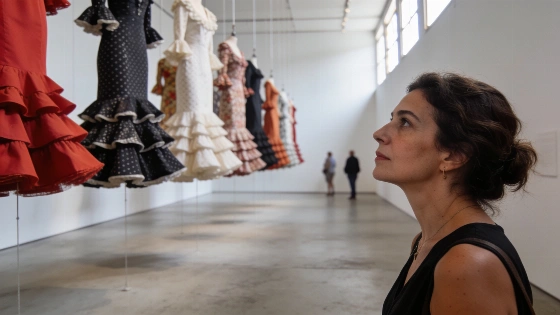
Her method is direct. She takes the stereotypical "cañí" image and pushes it until its assumptions show. In Techo de ofrendas, hundreds of flamenco dresses hang like a collective ex-voto. In Lunares, a flamenco dress carries marks made with her own blood. Tartero presents a life-size stuffed fighting bull. Musical Dancing Spanish Doll(s) takes apart the familiar Spanish doll through sardonic theatre.
Albarracín emerged during the 1990s and early 2000s with feminism built into the form of her work. Her own body often becomes the stage. In 2015, she appeared as a bullfighter on the cover of the magazine "Toros". She held a pot and used it as a symbol of the promise of an easier life for women. She compared the culture of the fight with women's daily struggles.
The institutional recognition now extends beyond the Reina Sofía and IVAM. The award coverage also notes the presence of Albarracín’s work in collections including Es Baluard, CAAC Sevilla, Artium, MUSAC, CA2M and DA2, alongside French institutions.
Her work reached a wider public through its connection with Rosalía's "Berghain" videoclip. Viewers found echoes of Albarracín's earlier pieces, especially the 2004 performance "Viva España". In that work, she walked through central Madrid in a yellow coat, heels and identical sunglasses while a popular band repeated the pasodoble of the title.
Since 1999, Albarracín has said, she has examined how Spain is seen from abroad and from within. Folklore, celebration and violence can share the same cultural space. Her work puts them in one frame.
The question is simple. Who gets to define Spanish identity? And what happens to people left out of its traditional imagery?
The gap between recognition abroad and recognition at home has lasted for years. "Viva España" belongs to four collections, all outside Spain: the Louis Vuitton collection owned by Bernard Arnault, the Paris City Museum of Art, a private collection in Washington and another in Portugal. Spain's delayed response is notable as Madrid continues to draw attention for other public conflicts, including the housing protest report.
Albarracín has argued that Spain has been slow to look at itself. She has still worked extensively in the country and appeared in its museums and exhibitions. The new prize addresses part of that imbalance.
It does not soften her critique. It gives that critique official visibility.
The award places a feminist reading of Spanish tradition inside the national canon. It also confirms that folklore can be treated as a structure of power, not only as decorative heritage. Albarracín refuses to separate celebration from conflict or beauty from exclusion.
By giving her its highest national prize for plastic arts, the Ministry of Culture has added domestic institutional weight to an artistic language that Spain often encountered first through foreign collections and international exhibitions.