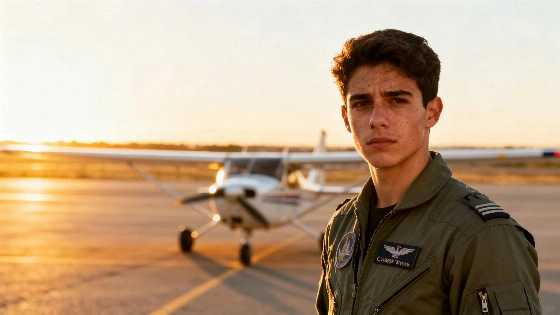
20-year-old Pilot from Madrid: The Price of a Cockpit Dream and Why Not Everyone Reaches the Finish Line. At just 20 years old, David Virosta is already training future pilots and has amassed hundreds of thousands of followers. He shares why pursuing a career in aviation requires not only financial investment but total dedication, and what awaits those who decide to follow in his footsteps.
David Virosta sat at the controls for the first time not because he grew up in a family of pilots, but because he was sure from childhood that his place was in the cockpit. Today, at 20, he works as an instructor at the European Flyers school at Cuatro Vientos airfield and runs popular social media accounts, where almost 300,000 people follow his daily life.
The path to a pilot's license turned out to be not only long but expensive for David: according to the school's own estimates, training costs about 80,000 euros. To raise the necessary amount, his family pooled their efforts, and David himself combined his studies with seasonal jobs—working as a lifeguard and a Burger King courier. During this time, he almost completely gave up his personal life to focus on exams and flight hours.
First steps and career choice
Unlike many colleagues, Virosta had no relatives in aviation. After finishing school in the US, he immediately began training as a commercial pilot. The most difficult stage was the 14 theory exams, which, according to him, require maximum discipline and self-organization. During this period, he worked evenings and weekends so as not to rely solely on family support.
Working as an instructor: daily life and responsibility
David's day starts with a briefing: together with the student, they discuss the flight plan, weather conditions, and current NOTAMs—special notifications about the situation in the sky and on the ground. Then comes a thorough aircraft inspection, radio check, and engine monitoring. During the flight, the instructor is responsible not only for training but also for safety: dozens of aircraft can be in the Madrid skies at once, and mistakes are unacceptable.
Virosta admits that his favorite airport is O’Hare in Chicago, where he first experienced the scale of world aviation. He already has dozens of airfields and hundreds of flight hours behind him, but he considers his main task to be sharing his experience with those who are just starting in the profession.
The cost of a dream: how much does it cost to become a pilot
Training to become a commercial pilot in Spain is not only years of study but also a significant financial investment. According to European Flyers, the average course costs around €80,000. Deferred payment programs have appeared in recent years, but as David emphasizes, without a clear financial plan and family support, it is extremely difficult to complete this path.
He advises future pilots to study all the conditions in advance, not to expect quick success, and to remember that aviation requires continuous learning and keeping knowledge up to date. Besides civil aviation, there is also the military path, which can be an alternative for those not ready for substantial expenses.
Social media and the reality of the profession
Virosta began sharing his experience online to show that behind beautiful photos from the cockpit lies hard work, stress, and constant checks. His audience is mainly young people who dream of the sky but do not always realize how many exams, sleepless nights, and sacrifices of their usual life this choice requires.
He openly talks about the difficulties but emphasizes that safety always comes before content, and not all moments can be shown publicly. This approach makes him not only a popular blogger but also a reference point for future pilots.
The future of the profession and personal benchmarks
According to David, the pilot profession has changed over the past 10–20 years: modern airplanes have become more economical, and training is stricter and more technological. Procedures, checklists, and teamwork in the cockpit play a crucial role. He is convinced that artificial intelligence will not replace the crew but will become part of everyday operations on the ground and in the air.
In ten years, Virosta sees himself as a pilot for one of the Spanish airlines and an instructor at a flight school. His main role model is his own mother, who taught him not to give up in the face of challenges. For those who only dream of the sky, he advises: if there is a true passion for aviation, you should go all the way, but be prepared for sacrifices and constant growth.
Stories of young professionals choosing demanding and high-cost occupations are becoming increasingly prominent in Spain. For instance, similar challenges are faced by truck drivers, who spend weeks away from home and family in pursuit of higher salaries—read more about this in our feature on the life of a Spanish driver on international routes. on russpain.com.