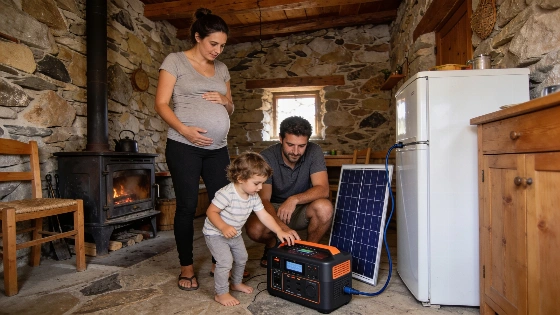
A Spanish family moved to a remote mountain cabin to see if modern life is possible without the power grid. Their experiment with solar panels and a portable battery reveals the real savings, compromises, and lessons of off-grid living in Spain’s countryside.
When Íker, his pregnant wife, and their young daughter left their city apartment for a stone cabin deep in the Spanish mountains, their goal was clear: find out if a modern family can truly live off the grid without sacrificing comfort. Over several weeks, they put solar self-sufficiency to the test, tracking every watt and euro saved.
The family’s daily electricity use averaged around 1,800 Wh—enough to run essentials but far below typical urban consumption. With just one solar panel and six hours of sunlight, they managed to cover their needs, relying on a 3 kWh portable battery to store energy for cloudy days and nighttime use. The setup powered their fridge, lights, and work devices, but required careful planning and strict prioritization.
Adapting to Solar Limits
Íker identified three main ways to live without a traditional power supply: drastically cutting technology and using wood for heat and cooking; relying on fuel generators, which bring noise and pollution; or, as they chose, combining solar panels with a portable battery. Their hybrid approach meant using gas for cooking and a wood stove for warmth, reserving electricity for the most essential appliances. This strategy, he noted, slashed about 80% of the energy use compared to a typical home.
Choosing energy-efficient devices was crucial. Laptops and LED lights stretched battery life, but high-demand appliances were off-limits. The family learned that off-grid living isn’t about replicating city habits, but about adapting routines to the sun’s rhythm and the battery’s limits.
Counting the Real Savings
For homes already connected to the grid, the upfront cost of a solar kit—around €1,900—translates to direct savings of about €125 per year in northern Navarra, with higher returns in sunnier regions like Andalusia. Reducing contracted grid power can add another €100 in annual savings, bringing the total to roughly €236 a year. At this rate, the investment pays for itself in about eight years of daily use.
But for truly isolated homes, the economics shift. Avoiding the cost of extending power lines—often tens of thousands of euros—means the solar system can pay off in as little as four years, especially when fixed grid fees are factored in. The family’s experience highlights how the benefits depend on location, sunlight, and whether a grid connection already exists.
Beyond the Cabin
Íker argues that portable solar stations shouldn’t be seen as an all-or-nothing solution. Their flexibility allows them to power not just rural homes, but also camper vans or temporary setups—much like the compact electric campers featured in recent innovations in mobile living. The key, he says, is learning to match energy use to what the sun provides, rather than expecting unlimited power on demand.
As reported by Talent24h, the family’s trial shows that energy independence is possible, but it comes with trade-offs. True off-grid living in Spain means embracing efficiency, planning, and a willingness to change habits—along with the reward of lower bills and a new sense of autonomy.