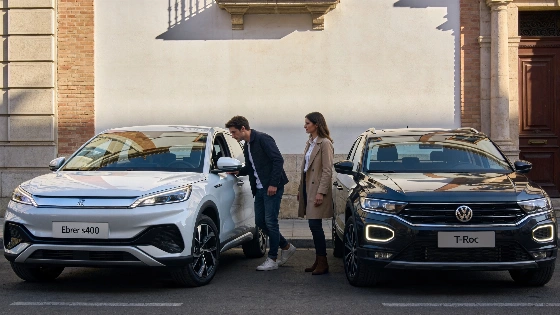
Ebro s400 vs Volkswagen T-Roc: Is It Worth Saving on a Chinese SUV? The new Ebro s400 offers hybrid technology and a rich set of features at a price significantly lower than its European competitors. We compared it to the Volkswagen T-Roc to evaluate whether the savings are justified and if the Chinese SUV stands a real chance in the market.
When a new SUV with a hybrid system and a price under 20,000 euros appears on the Spanish market, it immediately attracts attention. The Ebro s400 is a recent example: this Chinese brand offers a model whose equipment and power challenge the recognized segment leader, the Volkswagen T-Roc. But does the price difference really justify choosing the Ebro?
Dimensions and capacity
Although the Ebro s400 is formally classified as a B-SUV and the Volkswagen T-Roc as a compact crossover, the difference in size is minimal. The German SUV is just 5 centimeters longer (4.37 m vs 4.32 m), both are equally wide at 1.83 m, and the Ebro is even taller (1.64 m vs 1.57 m). The wheelbase is almost identical: 2.61 m for Ebro and 2.62 m for Volkswagen. The T-Roc leads in trunk volume: 475 liters versus 430, and with the seats folded, the gap widens—1,350 liters for Volkswagen against 1,155 for Ebro.
Technology and engines
The main difference lies in the approach to hybrid technology. The Ebro s400 is equipped with a full hybrid system: a 1.5 DHE petrol engine (95 hp) works together with a 204 hp electric motor, offering a combined output of 211 hp and a DHT automatic transmission. This setup accelerates to 100 km/h in 8.7 seconds, with an average consumption of 5.3 l/100 km and CO2 emissions of 120 g/km.
The new-generation Volkswagen T-Roc is available only with mild hybrids based on the 1.5 eTSI. The base version has 116 hp, 220 Nm, a 7-speed DSG automatic, and front-wheel drive. Average fuel consumption is 5.5 l/100 km, emissions are 125 g/km. The more powerful option offers 150 hp, 250 Nm, consumption of 5.6 l/100 km, and emissions of 128 g/km. Fully-fledged hybrids and a T-Roc R version with 335 hp are expected in the future.
Price and equipment
Price is the main selling point of the Ebro s400: the starting price is €19,990. For comparison, the base Volkswagen T-Roc costs at least €30,570. The difference is more than €10,000, which is especially significant in the affordable SUV segment.
At the same time, even the base Premium trim of the Ebro s400 offers 17-inch alloy wheels, LED headlights, keyless entry and start, dual-zone climate control, sports seats, two 12.3-inch digital displays, rear parking sensors, voice control, and an extensive set of safety systems (ADAS).
The standard Volkswagen T-Roc comes with 16-inch wheels, LED lighting, lane keeping assist, blind spot monitoring, adaptive cruise control, front and rear parking sensors, and wireless smartphone integration.
A practical choice
If we compare technical specifications and equipment, the Ebro s400 looks convincing: it's more powerful, more efficient, and cheaper. However, the Volkswagen T-Roc has its own strengths—interior quality, brand reputation, and a wider range of versions, including promising hybrid options. For those seeking maximum value for their money, the Ebro s400 could be a real alternative, especially if savings and modern features are a priority.
Interestingly, the trend toward new players with hybrid technologies and aggressive pricing is already changing the market. Similar processes are happening in the premium segment as well: for example, Audi recently introduced the hybrid RS 5 with a unique torque vectoring system—read more about this in the article about the hybrid Audi RS 5.
Ultimately, the choice between the Ebro s400 and the Volkswagen T-Roc depends on your priorities: if price and equipment are important, the Chinese SUV looks very attractive. However, if brand, quality, and long-term reliability come first, the German option remains a strong contender.