Hyundai is aiming for a profitability rate above 9% by 2030, driven by major investments in the US, a surge in robotics and robotaxi development, and a sweeping renewal of its model lineup. The plan includes over 100 new or updated vehicles and a sharp focus on electrification.
Hyundai has set an ambitious course for the end of the decade, targeting a profitability margin above 9% by 2030. The company’s roadmap is anchored in aggressive expansion in the United States, a major push into robotics and autonomous vehicles, and a comprehensive overhaul of its global product range. By 2030, Hyundai expects to reach 5.55 million vehicle sales worldwide, supported by the launch or renewal of more than 100 models and the rollout of extended-range electric vehicle (REEV) technology.
Central to Hyundai’s strategy is a $26 billion investment in the US through 2028, aimed at boosting local vehicle production and advancing steel and robotics capabilities. The Santa Fe EREV, set to debut in 2027 and built in Alabama, will be the brand’s first US model with extended-range electric technology, offering a combined range of over 600 miles (965 km). Hyundai plans to increase its global production capacity by 1.27 million units by 2030, with half a million of those in the US, including a 200,000-unit expansion in Georgia. The company is also raising its local parts sourcing target for the US from 60% to 80% by 2030, and expects hybrid models to account for half of its US sales, all produced in Alabama and Georgia.
Our fundamentals are stronger than ever — we are the world's third-largest automaker and the second most profitable, and that gives us the strength to keep investing even as others pull back.
In Europe, Hyundai’s focus will be on electrification, aiming to cover 85% of the market with electrified vehicles, including five new SUVs and light commercial vehicles. The company’s goal is to sell more than 420,000 electric vehicles in Europe by 2030, a significant jump from the 116,000 units sold in 2025. This mirrors a broader industry trend, as seen in Hyundai’s earlier announcement to launch over 100 new vehicles globally by 2030, detailed in a previous analysis of the brand’s global expansion.
The premium Genesis brand is also set for rapid growth, with plans to expand from 24 to over 40 markets and reach 350,000 units sold by 2030. Genesis will establish more than 270 sales points worldwide, including a long-awaited entry into Spain in the fourth quarter, following recent launches in France, the Netherlands, Tunisia, and Morocco. Further expansion is planned for Austria, Denmark, Poland, Portugal, and eventually India and the Asia-Pacific region.
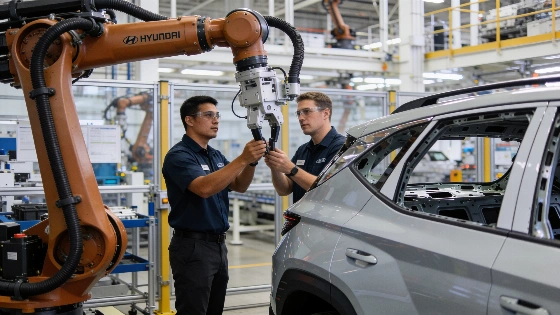
Hyundai’s robotics ambitions are advancing through collaboration with Boston Dynamics. The company recently opened the Robot Metaplant Application Center (RMAC) in the US, where AI-powered manufacturing robots are trained and tested before deployment. By 2028, Hyundai expects to introduce the humanoid Atlas robot at its Georgia plant, with annual production capacity for these robots reaching 30,000 units by 2030. The company is also exploring financing options for robot sales.
On the autonomous vehicle front, Hyundai will launch its first Waymo Ioniq 5 robotaxis in the US in the fourth quarter, manufactured in Georgia with a local supply chain. Motional, Hyundai’s autonomous driving subsidiary, will begin robotaxi service in Las Vegas by year-end, with plans to expand to more cities by 2027.
Reflecting these developments, Hyundai has revised its 2030 profitability forecast upward, now aiming for margins above 9%, compared to the previous 8–9% target. This optimism is underpinned by the expansion of hybrid models across all segments and a company-wide cost reduction plan. Hyundai expects to lower its cost of sales ratio by three percentage points, driven by lifecycle cost innovation, material cost reductions, and increased localization.
José Muñoz, president and CEO of Hyundai Motor Company, emphasized during the investor day that the group’s fundamentals are stronger than ever, positioning Hyundai as the world’s third-largest automaker and the second most profitable. This financial strength, he noted, enables continued investment even as competitors pull back.
For the current year, Hyundai maintains its operating profit margin forecast at 6.3–7.3%, up from 6.2% in 2025, despite a challenging business environment. The company attributes this to rising hybrid sales and the impact of new model launches in the second half of the year.
According to elespanol motor, Hyundai’s strategy reflects a broader industry shift toward electrification, automation, and regional production. The company’s focus on the US market, robotics, and premium expansion signals a clear intent to secure long-term profitability and global relevance as the automotive landscape evolves.