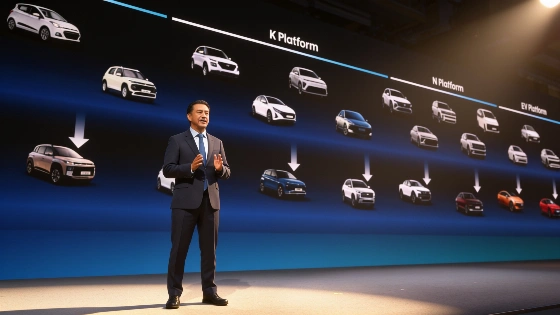
Hyundai has announced a sweeping strategy to launch over 100 new vehicles by 2030, including models with extended-range electric technology. The plan aims to counter Chinese competition and reshape the brand’s global presence.
Hyundai has set an ambitious course for the next decade, revealing plans to introduce more than 100 new vehicles worldwide by 2030. The announcement, made during the Investor Day 2026 event, signals a determined response to the growing influence of Chinese automakers and a rapidly evolving global market.
In the coming eight months alone, Hyundai will roll out seven new models, with at least 18 of them targeting fresh product lines and market segments. The company’s global push is evident in its launch schedule: 58 new vehicles are slated for North America, 49 for Korea, 41 for Europe, 26 for India, and 22 for China. Recent unveilings, such as the Hyundai Tucson 2027, the new Elantra, and the Ionic 3, are just the beginning of this expansion.
Our goal is to offer customers the electric driving experience without the anxiety of limited range or charging delays
One of the most notable innovations is the introduction of extended-range electric vehicle (EREV) technology. Hyundai confirmed that a Santa Fe variant with extended range will debut in the first half of 2027, promising a combined range of over 966 kilometers. This model will be produced at the Alabama plant in the United States and is designed to deliver an electric driving experience without the anxiety of limited range or charging delays.
The strategy also includes a new global B-segment SUV, with Europe set to receive a second model in this highly competitive category. Meanwhile, India will see the arrival of a smaller, all-electric A-segment crossover, tailored to local market demands.
Electric Growth in Europe
Hyundai’s European roadmap is centered on electrification. The company confirmed that five new electric crossovers and light commercial vehicles will join its lineup, aiming to boost electric vehicle sales in the region from 116,000 units in 2025 to more than 420,000 by 2030. Two upcoming B-segment vehicles will be fully electric, complemented by a large D-segment electric SUV and two electric vans.
India is also a key focus, with a new electric crossover featuring advanced infotainment and Level 2 semi-autonomous driving set for launch in the fourth quarter. A mid-size SUV with a combustion engine will follow, reflecting Hyundai’s multi-technology approach in diverse markets.
Strategic Shift in China
Hyundai is seeking to regain momentum in China, starting with the Ioniq V and followed by a wave of electric and extended-range models in 2027. The B-SUV will be fully electric, while the C-SUV will offer both electric and extended-range options, targeting up to 600 kilometers of range. Three D-segment vehicles—a sedan, an SUV, and an MPV—are also planned, each equipped with Level 3 autonomous driving and next-generation propulsion systems.
This aggressive expansion comes as global automakers face increasing regulatory scrutiny and shifting consumer expectations. For example, Tesla recently faced a massive recall in China due to safety concerns, highlighting the competitive and regulatory pressures in the world’s largest car market.
Genesis: Luxury Ambitions
Hyundai’s luxury division, Genesis, is also undergoing a major transformation. The new GV90 and GV80 Hybrid lead the brand’s renewal, with a planned extended-range SUV in 2027 that promises over 1,030 kilometers of range. Genesis has outlined 22 launches for North America alone, accounting for nearly a third of its new models in the region, though this figure includes various model variants.
Genesis is preparing to enter new markets, including India and Asia-Pacific, with the goal of being present in over 40 countries and reaching annual sales of 350,000 units by 2030.
Context and Outlook
Hyundai’s strategy reflects a broader industry trend toward electrification, diversification, and regional adaptation. The company’s focus on extended-range technology and rapid model rollout is designed to address both consumer concerns and regulatory demands. As competition intensifies, especially from Chinese brands, Hyundai’s next moves will be closely watched by industry observers and consumers alike.