Hyundai is racing to launch the IONIQ V, a China-focused electric sedan set for September 2026. This model leads a 20-car surge and marks a sharp turn in the brand’s global strategy.
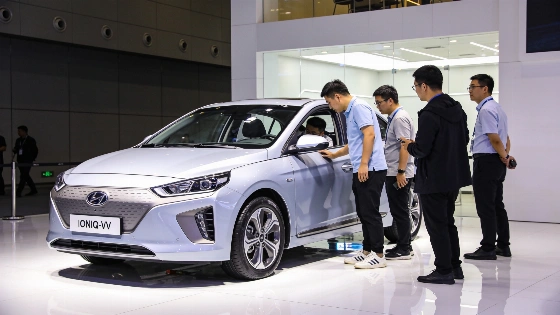
Hyundai moved fast. Just fifteen days after showing the VENUS prototype in Beijing, the company rolled out the production-ready IONIQ V at the city’s auto show. No Korean, European, or Japanese brand would have tried this pace a few years ago. Hyundai is not slowing down. This is the start of its boldest electric push yet.
The IONIQ V stands apart from the rest of the IONIQ lineup. It is built for China. The design, called The Origin, drops the rounded look of the IONIQ 6 for a sharper, wedge-shaped profile. The V means VENUS, not five. The car’s fastback shape, frameless doors, and floating mirrors are all tuned for better aerodynamics and local tastes. Buyers get eight color choices, including gold and purple. This car looks nothing like what Europeans expect from Hyundai.
Official pre-orders for the IONIQ V began at the Chengdu Auto Show in August 2026, weeks before the public launch.
Inside, the IONIQ V drops the old-school instrument cluster. Instead, a 27-inch 4K screen stretches across the dash. There’s also a head-up display. The system runs on a Qualcomm Snapdragon 8295 chip. Baidu’s Ernie Bot and ByteDance’s Doubao handle voice commands. This is deep localization for China. Safety gets a boost with nine airbags and a system that brakes if the driver hits the accelerator by mistake.
Hyundai and BAIC are all in. They have put 8 billion yuan into their joint venture, Beijing Hyundai. The plan: launch 20 new models in China over five years and hit 500,000 units a year. The IONIQ V leads the charge. A new SUV is already set for early 2027. This is more than a product launch. Hyundai is going after the world’s toughest EV market.
According to several industry publications, the IONIQ V is the first IONIQ-branded model developed exclusively for the Chinese market, marking a strategic shift as Hyundai seeks to regain share in China’s rapidly growing NEV segment.
The IONIQ V sits on the E-GMP platform, the same base as the IONIQ 5, IONIQ 6, and KIA EV6. But there’s a twist. CATL supplies LFP batteries in 53.5 and 66.8 kWh sizes. That’s a switch from the NMC batteries used in Europe. All versions are rear-wheel drive. Buyers can pick 140 kW (190 hp) or 168 kW (228 hp) motors. Chinese CLTC range is 520 to 650 km. Under the stricter WLTP standard, that’s about 421 to 527 km. The trade-off is clear. LFP batteries have less energy density, but they cost less and handle daily full charges better.
Charging details are still secret until September 29. The car uses 800-volt tech, so fast charging is possible. LFP batteries usually charge slower than NMC, but the hardware is ready. For assisted driving, Hyundai teamed up with Momenta, a top Chinese ADAS supplier. The car offers highway navigation help.
Pre-sale prices for the IONIQ V started at 119,900 yuan for the 540 Max, 129,900 for the 540 Max+, and 139,900 for the 650 Max+. That’s about €15,300 to €17,800. These are early prices. Final launch prices should be lower. For comparison, the IONIQ 6 starts at €44,770 in Spain with a 63 kWh battery. Hyundai advertises a €30,485 price, but only with strict financing and trade-in deals. The price gap is huge. China’s 13% VAT, fierce price wars, and cheaper LFP batteries all matter here.
Hyundai wants to export. The company’s “In China, For China, To Global” slogan points to bigger plans. CEO José Muñoz named the UK, Europe, and the Middle East as possible markets for Chinese-made cars. But for the IONIQ V, only Asia-Pacific, Australia, the Middle East, and Latin America are in play. Europe is missing. There’s a reason. Beijing Hyundai did not join the EU’s anti-subsidy probe. Any imports would face a 45.3% tariff before shipping, dealer markup, and VAT. The only way in would be to accept a high minimum price. That would kill the IONIQ V’s cost edge over the IONIQ 6.
There’s another roadblock. The IONIQ V’s software is tied to Chinese AI and ADAS systems. It would need major changes to meet European cybersecurity and data rules. The UK and Norway, which do not add extra tariffs, are the most likely options if the car ever comes to Europe.
Hyundai is not alone. As reported earlier, other brands like Geely have also stepped up their EV game to keep up with local rivals and global shifts.
The IONIQ V may never reach Spanish showrooms. Still, its impact is spreading. The slim light bar replacing pixel LEDs is already showing up on new Hyundai models. The company now calls China its main base for electric vehicle development, following moves by Volkswagen and BMW. An extended-range IONIQ V could come later. The lineup will grow into bigger segments. But the real story is the method. Hyundai cut development time, teamed up with Chinese suppliers for batteries, software, and driver aids, and got the car to market months ahead of schedule. If this works in China, European buyers will feel it soon—in tech and in price.