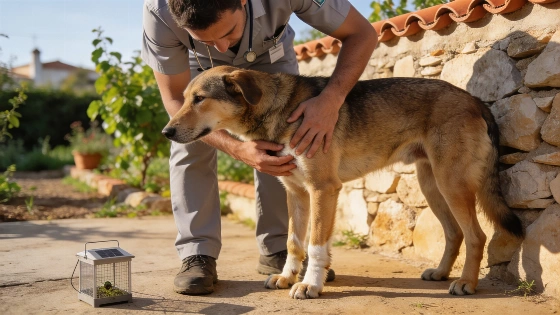
A new data system will monitor canine leishmaniosis across the Iberian Peninsula. It combines climate records, sand fly surveillance and veterinary diagnoses to forecast where risk may rise.
Dogs are the main domestic reservoirs linked to human infection from Leishmania infantum in the region. The parasite is spread by sand flies. Seroprevalence and incidence change across time and place, with climate, ecology, social conditions and environmental factors shaping the risk.
That risk is uneven. A new system is being developed to track it across Spain and Portugal. The PLANET4HEALTH project will bring scattered environmental and health records together to forecast where conditions may become more favourable for transmission.
LeishVet has published an updated review and recommendations on leishmaniosis in cats, underscoring that research and guidance on the disease and its vectors remain active topics in European veterinary medicine.
The system will use older records and near-real-time measurements of temperature, humidity, rainfall and soil moisture. It will also assess broader climate variables, sand fly monitoring, veterinary diagnostic records and serological results for leishmaniosis.
Registered CanL cases will be included too. So will information on the domestic dog population.
The point is to connect signals that usually sit in separate surveillance systems. That could give officials and veterinary services a clearer view of short-term changes in disease risk.
Statistical and machine-learning models will track seasonal changes in sand fly activity. They will estimate the risk of canine leishmaniosis and produce short-term forecasts for specific areas.
The same framework is intended to support future projections. The source material does not describe a finished public service. It describes a system that is being developed, refined and assessed through the project's first case study.
The broader research field is still developing: materials on leishmaniosis appeared in Parasites & Vectors in September 2026. This supports the view that vector surveillance and disease-risk modelling are part of an ongoing research effort rather than a completed, publicly confirmed forecasting service for Spain and Portugal.
Earlier and ongoing national and European sand fly surveillance efforts will provide part of the data. Other sources include veterinary clinical and diagnostic databases in Portugal and Spain, along with national public health monitoring systems.
Formal data-sharing agreements will support the work. They will bring together information on animal health, human health and indirect indicators of canine disease.
The project uses a One Health approach. Dogs, vectors, people and the environment will be studied within one analytical framework.
An earlier health report examined a similar surveillance question: how infectious risks can be identified before they become harder to manage.
PLANET4HEALTH will not depend on models alone. Veterinarians, public health authorities and other intended users will review the results through questionnaires, online feedback and co-creation workshops.
Their feedback will be used during the project. It will help assess whether the system is useful, feasible and workable in real operational settings.
Climate change, environmental degradation and greater movement of people and animals could expand the vector's distribution. They could also raise transmission risk.
The proposed system links immediate monitoring with longer-term projections. It does not treat canine leishmaniosis as a fixed Mediterranean problem.
The framework joins climate, entomological, veterinary and public health evidence. Users will then test the results in practice.
That is the work so far.
If the process produces reliable spatial forecasts, it could improve proactive risk management and offer a model for other endemic regions. For now, the main achievement is the construction and evaluation of the framework itself.
That is a more credible route to preparedness than relying on isolated diagnoses after transmission has occurred.