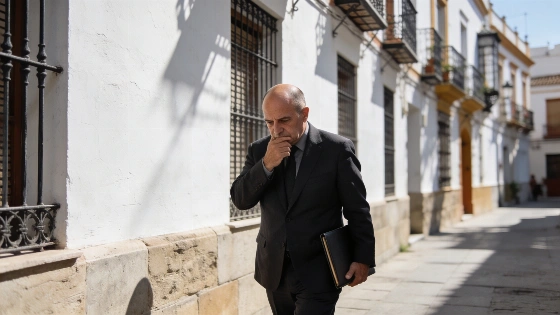
Gaspar Sarrias Again Under Investigation: Leire Case and ERE Sentence Overturned. Former Andalusian government advisor Gaspar Sarrias is once again in the spotlight. He is suspected of involvement in a scheme related to the Leire case. Earlier, part of the sentence in the ERE case was overturned by the Constitutional Court.
Another scandal is unfolding in Andalusia around Gaspar Sarrias — one of the region's most influential politicians of recent decades. The former government adviser and ex-secretary of the Jaén socialists has become a key figure in a new investigation: Judge Santiago Pedraz has charged him in the Leire case, which is linked to attempts to influence legal proceedings affecting the interests of the party and the government.
According to the investigation, Zaño Sociedad Consultora, a company owned by Sarrias, hired former socialist Leire Díez in 2024. Over four months, she received 16,000 euros for her work. Investigators are checking whether this scheme served as a way to finance PSOE structures, and whether the assignment was connected to attempts to determine the role of former commissioner José Manuel Villarejo in the ERE case. During questioning in 2026, Sarrias stated that the initiative was his own, not the party’s, and that the work did not confirm Villarejo’s involvement.
Sarrias's story is closely linked to Andalusia’s political life. His family suffered repression during the Franco era: his father and both grandfathers were imprisoned, and one was executed by firing squad. Sarrias began his political career at 17 as a PSOE activist. In Jaén, he built a strong party school, and at 27 was elected to the Andalusian parliament. In 1988, he became advisor to the president, then head of industry, supervising business support policies that later formed the basis of the ERE case.
For 13 years, Sarrias remained a key figure in the government of Manuel Chaves, and after Chaves stepped down, he became vice president and even briefly served as acting head of the autonomous community. He later moved to Madrid, where he took up a position in the Ministry of Territorial Cooperation. However, after the ERE case was opened and he was subsequently sentenced to nine years of disqualification from public office, Sarrias left the ranks of the PSOE. The Constitutional Court later overturned part of the sentence, but the former advisor’s political career was left in doubt.
Sarrias now runs a private law practice, works with various clients including sports federations, and maintains contacts with former colleagues. According to RUSSPAIN, he often visited those convicted in the ERE case and their families. In recent days, amid new searches and interrogations, those close to him have noticed a marked change in his behavior.
The context of the Sarrias case recalls other high-profile corruption scandals in Spain. For example, recently former Prime Minister Alberto Aznar called for new elections amid corruption allegations, which has once again raised the issue of transparency in government and political accountability.
For reference: the ERE case became one of the largest corruption scandals in Andalusia's history, leading to the conviction of 19 high-ranking officials. In 2025, the Constitutional Court partially overturned the sentences, sparking renewed debate about the boundaries of responsibility and the role of party structures in such schemes. The situation surrounding Sarrias highlights just how acute the issue of trust in political institutions and transparency of their operations remains in Spain.