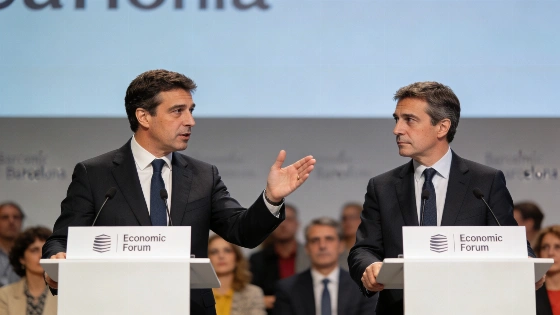
Illa and Rueda Engage in Public Dispute Over New Autonomous Funding Model. At the Cercle d’Economia forum in Barcelona, the leaders of Catalonia and Galicia publicly debated the reform of autonomous community funding. Illa accused his opponents of lacking alternatives, while Rueda criticized attempts to divide the regions.
A heated debate broke out at the Cercle d’Economia economic forum in Barcelona between Catalonia's president Salvador Illa and Galicia's leader Alfonso Rueda. The cause was an initiative to reform the system of autonomous community financing, which the central government has begun discussing with the regions. Illa, representing the PSC, and Rueda, from the PP, exchanged open criticisms on this issue for the first time on the same stage.
Rueda accused Madrid of conducting the negotiations in violation of the principle of equality—in his words, 'the game of bilateralism' undermines the country's common interest. He stressed that the current scheme is being discussed mainly between the socialist government and Catalonia, while other regions receive only formal phone calls from Finance Ministry representatives to finalize details of a model that is already finished. Rueda also recalled the 'Santiago Declaration', where regions receiving less funding expressed dissatisfaction with the new distribution, despite Galicia being entitled to an extra 587 million euros.
Salvador Illa, in turn, stated that the opposition does not have its own alternative concept and called for constructive dialogue based on concrete proposals. He emphasized that Catalonia has always stood for solidarity but does not intend to limit its own development for the sake of others. Illa also pointed out that attempts to revise the autonomous system, especially if a PP and Vox coalition comes to power, could lead to 'regression' and do not reflect the sentiments of the majority of Catalans.
Basque leader Imanol Pradales (PNV) also took part in the discussion, reminding that any changes in funding and even debt write-off issues have a direct impact on the Basque Country's annual contribution to the overall budget. He stressed that accusations of a lack of solidarity do not reflect reality, as his region also contributes to the territorial cohesion fund.
Rueda separately criticized the government's inability to approve new state budgets and called attempts to reform autonomous communities' financing an even more complex task. He insisted that such issues should be discussed on a multilateral basis in the Council for Financial and Fiscal Policy, rather than through individual agreements with separate regions.
During the discussion, Illa also recalled that Catalonia would not seek permission to put forward its initiatives, and that the issue of debt cancellation from the Autonomous Liquidity Fund remains open — according to him, regions that do not wish to participate in this measure may opt out.
According to russpain.com, such public clashes between regional leaders over the allocation of funds are becoming increasingly visible amid political instability. Similar conflicts have already arisen in other areas: for example, in Madrid, former interior ministers gave conflicting testimonies in the case over surveillance of Bárcenas, which was analyzed in detail in the article about disagreements among former interior ministry officials in the Kitchen case trial.
For reference: the model of financing for the autonomous communities in Spain determines how state funds are allocated among the regions. In recent years, debates around this system have intensified due to differences in demographics, economic potential, and the political interests of the autonomous regions. Decisions to change the scheme require the consent of the majority of regions and approval at the central government level. Any changes can significantly affect budgets, social programs, and investment opportunities in various parts of the country.