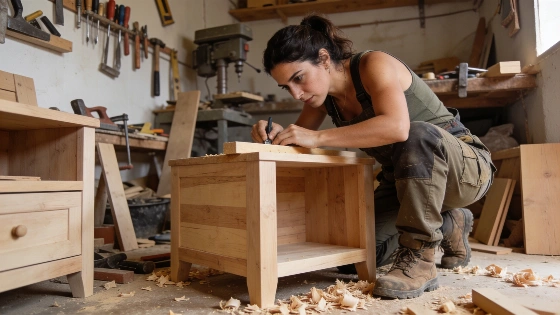
Isabel Obreo left her engineering career to open a bespoke carpentry studio in Extremadura. She now crafts solid wood furniture to order, facing challenges in pricing and self-valuation. Her story highlights the risks and rewards of starting over.
In Extremadura, a region not often associated with radical career shifts, Isabel Obreo has become a striking example of professional reinvention. After more than six years designing electronic products, Obreo, trained as an industrial designer, made the decision to leave her secure job and open her own carpentry workshop, Laal. The move came at a time when she was raising two young daughters and had little practical experience in woodworking. Her motivation stemmed from a growing sense that her creative skills were being sidelined in her previous role.
Obreo’s transition was marked by uncertainty and financial risk. She gave up nearly eight years of seniority and a stable income, admitting that the initial step was driven by both fear and a desire for personal liberation. Without formal carpentry training, she rented a small space, purchased basic machinery, and relied heavily on online tutorials to build her skills. Early on, she struggled to see herself as a professional in the field, often feeling like an outsider and grappling with impostor syndrome.
One of the most complex challenges Obreo faced was learning to price her work. She describes the process of preparing quotes and valuing her time as a source of significant stress. Today, her business model is strictly made-to-order, with no inventory. Clients typically find her through social media, word of mouth, or by passing her workshop. Each project begins with a design sketch and a discussion of wood options, as the choice of material—chestnut or walnut, for example—directly affects both the look and the cost. Once a quote is accepted, Obreo requires a 50% advance payment, which covers materials and hardware and secures the client’s commitment. She then creates a 3D model for client approval before starting production, sharing progress photos throughout the process. The remaining balance is paid upon completion. In addition to furniture, she offers in-person creative carpentry courses in Extremadura.
Obreo continues to identify as both an engineer and a cabinetmaker, noting that her technical background remains essential in her new craft. Each custom piece presents unique technical and creative challenges, requiring ongoing adaptation and learning. Her experience reflects a broader trend of professionals in Spain seeking fulfillment outside traditional career paths, even at significant personal and financial risk. This echoes the resilience seen in other stories of reinvention, such as the case of a Barcelona family who rebuilt their lives after a devastating fire, as reported in a recent feature on overcoming adversity in Catalonia.
Spain has seen a gradual rise in small-scale artisanal businesses, particularly in regions like Extremadura where economic diversification is limited. The country’s self-employment sector remains challenging, with high social security contributions and limited access to credit. For women, especially those balancing family responsibilities, the barriers to entrepreneurship can be even higher. Obreo’s story illustrates both the difficulties and the sense of agency that can come from redefining one’s professional identity. Her insistence on upfront payment and transparent pricing is increasingly common among independent artisans, reflecting a shift toward valuing skilled manual work. As Spain continues to navigate economic uncertainty, such individual stories highlight the evolving landscape of work and the enduring appeal of craftsmanship.