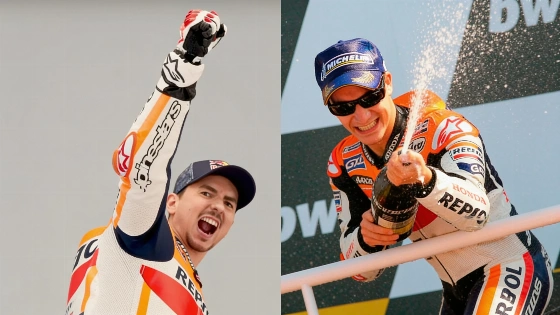
Jorge Lorenzo has spoken candidly about his intense rivalry with Dani Pedrosa, describing him as his most disliked competitor. The former MotoGP champion reflects on the roots of their conflict and how time has changed their relationship.
Jorge Lorenzo has never shied away from controversy, but his recent comments about Dani Pedrosa have reignited interest in one of MotoGP’s most notorious rivalries. In a revealing interview, the five-time world champion described Pedrosa as the rider he “hated the most” during his career—more than even Valentino Rossi or Marc Márquez.
Lorenzo’s words cut through the public image of Pedrosa as a reserved and likable figure. “Most people saw him as a really good person. But if you ask journalists, they’ll tell you Pedrosa was a bastard, rude and curt,” Lorenzo said on a podcast, highlighting the stark contrast between Pedrosa’s reputation and his behavior behind the scenes.
The rivalry between Lorenzo and Pedrosa reached its peak in the late 2000s, long before the infamous clashes between Marc Márquez and Valentino Rossi. Their animosity was so intense that even King Juan Carlos I attempted to broker peace between the two Spanish stars. The most memorable attempt came at the 2008 Jerez Grand Prix, where Pedrosa finished first and Lorenzo third. After the race, the king personally intervened, insisting the two shake hands in a symbolic gesture of reconciliation. “It didn’t help at all—we kept getting along just as badly,” Lorenzo recalled with a laugh.
Roots of the Conflict
Looking back, Lorenzo believes the origins of their feud were not solely personal. He points to Alberto Puig, Pedrosa’s long-time manager and mentor, as a key influence. “Pedrosa was rude because his manager from childhood into his twenties was Alberto Puig, who was a very direct and dry person. He was like a sporting father to him,” Lorenzo explained.
Puig, who discovered and guided Pedrosa from his earliest days in Spanish national competitions to the top tier of MotoGP, played a central role in shaping Pedrosa’s approach. Their relationship eventually fractured in 2013, with some in the paddock suggesting Puig’s influence contributed to Pedrosa’s departure from Honda.
Lorenzo also noted that Puig’s strict, almost military style left a mark on Pedrosa’s interactions with rivals. “Pedrosa clung to Alberto Puig and behaved very much like him. Even if he won’t admit it, there were rumors that Puig told Pedrosa not to talk to his rivals—not even to greet them,” Lorenzo said. The dynamic was further complicated by the fact that Lorenzo’s own manager at the time, Dani Amatriaín, had a longstanding feud with Puig dating back to their own racing days. “So it was really a four-way conflict,” Lorenzo concluded.
Time Heals Old Wounds
Over the years, the tension between Lorenzo and Pedrosa has eased. Both have retired from full-time racing, and the fierce competition that once defined their relationship has faded. Today, they are occasionally seen together, even sharing commentary duties during MotoGP broadcasts—a far cry from the days when they could barely exchange a handshake.
The Lorenzo-Pedrosa rivalry remains one of the defining stories of modern MotoGP, illustrating how personal dynamics, management influences, and the pressures of elite sport can fuel lasting grudges. For fans, it’s a reminder that the drama of racing often extends far beyond the track.
For context, Dani Pedrosa is widely regarded as one of the most talented riders never to win a premier class world title, while Jorge Lorenzo retired as one of Spain’s most successful motorcycle racers. Alberto Puig, after his split with Pedrosa, went on to become team manager for Repsol Honda, shaping the careers of other top riders. Their intertwined histories continue to shape the narrative of Spanish motorsport.