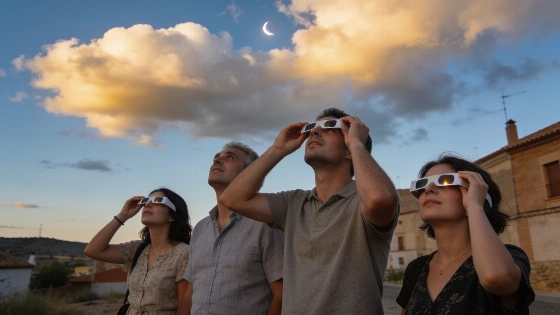
Meteorologist Jorge Rey warns of possible cloud cover during Spain’s total solar eclipse on August 12. His early forecast highlights risks for northern and eastern regions. Official Aemet updates are still pending.
Spain is preparing for a rare total solar eclipse on August 12, the first of its kind visible from the country since 1905. The event, expected to last just over 90 seconds, has generated widespread anticipation, but concerns about weather conditions threaten to overshadow the spectacle for many observers.
While the Agencia Estatal de Meteorología (Aemet) has yet to release its official forecast, young meteorologist Jorge Rey has stepped forward with an early warning. According to Rey, there is a significant chance of increased cloud cover, particularly in northern and eastern parts of the peninsula. He notes that evolving storms in mountainous areas could make it difficult to view the eclipse at sunset, when the phenomenon will reach its peak visibility.
The eclipse will begin at 19:30 in La Coruña, reaching its maximum at 20:28, with the sun at a low angle of 8 degrees. In Palma, the event starts at 19:38 and peaks at 20:32, just before sunset, with the sun barely above the horizon. The last opportunity to witness the eclipse will be in the Balearic Islands, but low sun angles and potential cloudiness may limit visibility there as well.
Authorities have emphasized the importance of checking the latest weather updates, as the most reliable cloud forecasts will only be available closer to the event. The Ministry of Science, Innovation and Universities has announced that Aemet will issue special daily forecasts for the eclipse in the coming days. A recent study using satellite data and mathematical models suggests that clear skies are possible, but local conditions could change rapidly.
Rey’s forecast, based on traditional cabañuelas methods, suggests that even isolated storms in mountainous regions could block the view for many hoping to see the eclipse. This uncertainty has led some to reconsider travel plans or seek alternative locations with a better chance of clear skies. As the date approaches, many are waiting for more precise updates from Aemet and other official sources.
Interest in the eclipse is high, not only for its rarity but also for its timing and visibility across different regions. The event’s short duration means that any cloud cover could completely obscure the experience. For those planning to observe, experts stress the need for proper eye protection and careful timing, as the window for viewing will be brief.
In the context of recent public events in Spain, such as the heightened security and logistical challenges seen during major festivals, the eclipse presents a different kind of organizational test. As noted in coverage of large gatherings like Barcelona’s Gràcia festivities, which faced both innovation and disruption, unpredictable weather remains a key factor in the success of public events. For more on how weather and security shape major Spanish gatherings, see this analysis of festival preparations in Barcelona: Barcelona’s Gràcia festival faces new challenges.
With the eclipse drawing near, all eyes are on the skies—and on the next updates from both official meteorological agencies and independent forecasters like Jorge Rey. The coming days will determine whether Spain’s rare astronomical event will be visible in all its glory or hidden behind summer clouds.