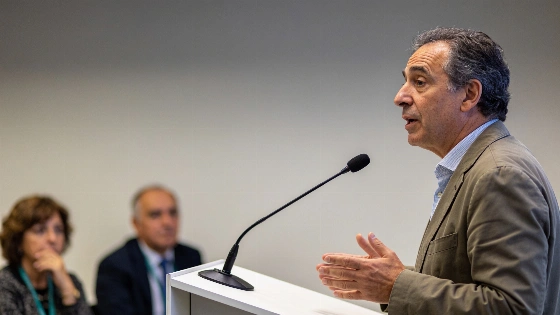
Juan de Dios Molina has taken over as president of the Sociedad Española de Psiquiatría Clínica after serving as vice-president. His board plans to focus on physical health in people with mental disorders and training for younger professionals.
The leadership change took place at the Sociedad Española de Psiquiatría Clínica’s V Congress in Zamora, where specialists discussed mental healthcare and clinical practice. Molina moves from vice-president to the society’s presidency, succeeding a board led by Edorta Elizagarate.
His new board has set priorities that include improving the physical health of people with mental disorders and training younger professionals. It also wants to strengthen collaboration between specialties and bring scientific advances into clinical care.
Molina has spent more than two decades in psychiatric care. His career also includes research and teaching. He has worked in both public and private healthcare, treating adults with mental disorders, with a particular focus on psychopharmacology and individual or group psychotherapy.
He is head of section at the Villaverde Mental Health Centre, which is linked to Madrid’s Hospital Universitario 12 de Octubre. His research at the Instituto de Investigación Sanitaria Hospital 12 de Octubre (i+12) focuses on neuroscience and mental health, including treatment-resistant depression and alternatives for patients who do not respond adequately to usual treatments.
Molina has taught at university level, including in Medicine and Criminology, and has also taught postgraduate Psychology courses. He has taken part in SEPC work on neuromodulation alongside Elizagarate.
The SEPC is preparing evidence-based clinical recommendations to guide the use of neuromodulation techniques in care, with a focus on efficacy and safety. The work is part of the society’s effort to bring research advances into patient treatment.