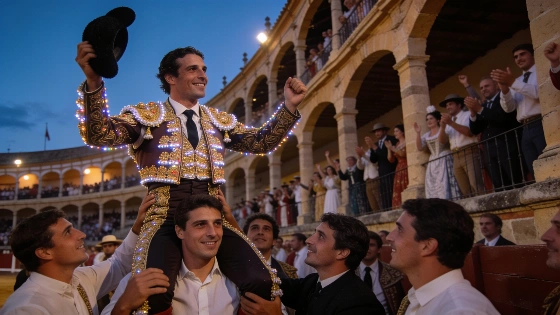
Juan Ortega delivered two memorable performances at the LXVII Corrida Goyesca in Ronda, earning three ears and sharing the exit on shoulders with Manzanares and Ventura. The event honored Antonio Ordóñez and filled the arena to capacity.
Juan Ortega left the Plaza de la Maestranza de Ronda as the clear standout of the LXVII Corrida Goyesca, cutting three ears and joining Manzanares and Diego Ventura in a celebratory exit on shoulders. Ortega, from Seville, brought a calm, classic style to a rainy afternoon, with faenas that combined precision and emotion.
The Goyesca, held on September 5, 2026, was organized as a tribute to Antonio Ordóñez and the traditions of Spanish bullfighting. The event took place in the newly restored Ronda bullring and drew a full house. Many spectators arrived in traditional dress, carriages circled the arena, and the atmosphere was thick with anticipation. The Real Maestranza de Caballería de Ronda, which manages the plaza, oversaw the restoration to keep the venue's historic character. Tickets sold out well in advance, reflecting the excitement around the Goyesca's return after a two-year break.
The 2026 Goyesca was dedicated to the 75th anniversary of Antonio Ordóñez's alternativa, adding a significant historical dimension to the event.
Ortega’s first bull from Garcigrande set the tone. He opened with a slow, controlled verónica, followed by chicuelinas and a series of ayudados that drew a strong reaction from the crowd. His faena mixed classic moves with some innovation, including a molinete invertido and a deep series with the right hand. After a clean kill, the president awarded one ear, though many in the crowd called for a second.
Morante de la Puebla, another headliner, struggled with bulls that lacked strength. His first bull gave him no options, and his second, despite a brief moment of promise, faded quickly. Manzanares had little to work with until the sixth bull, when he took advantage of the animal’s quality to earn two ears after a series of long, fluid passes and a well-placed estocada. Several Spanish outlets noted that Morante's difficulties were due to the weakness of his bulls, a point confirmed in post-event reports.
Diego Ventura opened the card with a bull for rejones from Ribeiro Telles, showing technical skill and showmanship. He secured two ears with daring quiebros and a pair of banderillas sin cabezada, confirming his reputation in the discipline.
The official card for the evening featured Diego Ventura on horseback with a bull from David Ribeiro Telles, followed by Morante de la Puebla, José María Manzanares, and Juan Ortega with Garcigrande bulls. This lineup was highlighted in pre-event announcements as a return to the classic Goyesca format after restoration works at the Ronda arena.
Pre-event Spanish press
As dusk fell, Ortega dedicated his final bull to José Miguel Arroyo «Joselito». The faena was slow and deliberate, each pass measured and full of feeling. The crowd responded with a roar, and after a decisive estocada, Ortega was awarded two more ears. The procession that followed, carrying Ortega, Manzanares, and Ventura to the statue of Antonio Ordóñez, gave the evening a sense of ceremony.
The official results: Diego Ventura, two ears; Morante de la Puebla, silence in both appearances; Manzanares, silence and two ears; Juan Ortega, one ear with strong petition and two ears. The Garcigrande bulls varied in quality, with three notable animals, while the Ribeiro Telles bull for rejones was manageable but lacked power. According to coverage by ABC and other major outlets, the event was marked by a high level of ceremony and tradition, reinforcing its place as a cultural landmark.
Ronda’s Goyesca remains a unique event in the Spanish bullfighting calendar, blending spectacle, tradition, and homage. Its ability to fill the arena and deliver moments of real artistry, even as debate around bullfighting continues, shows its lasting role in Spanish culture. For more on how tradition shapes major Spanish events, see this previous report.
This year’s Goyesca stood out not only for the technical level of the performances, but for the way Ortega and his peers honored the memory of Ordóñez and the Ronda school. While the future of bullfighting is debated, the sold-out crowd and the energy in the arena suggest that, at least in Ronda, the tradition remains strong. Ortega’s success is both a personal achievement and a reminder that the classic Spanish corrida, when performed at this level, still commands respect and passion.