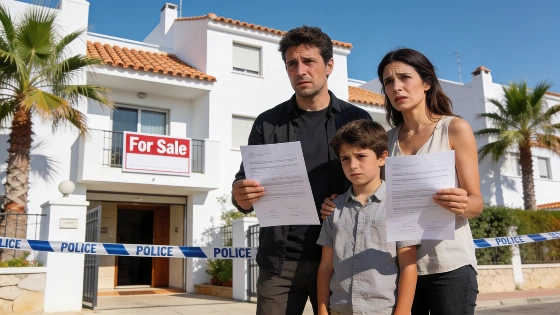
A Marbella court has frozen property registry changes in a suspected real estate scam. Nearly 200 families in Granada and Málaga are affected. Police and lawyers urge swift action to protect ownership rights.
Nearly 200 families in Granada and Málaga are at the center of a major real estate fraud investigation after a Marbella judge ordered an immediate freeze on property registry changes. The measure, prompted by a suspected scam involving the acquisition of Ávila Rojas debt and assets by a businessman with a criminal record, has halted all new registrations or ownership modifications across multiple property registries in both provinces. The case, now under the scrutiny of the National Police's Economic and Fiscal Crime Unit (UDEF), has exposed vulnerabilities in property documentation and left many long-term owners facing the risk of losing their homes.
According to the court order, the freeze currently affects five registries in Granada city, two in Motril, one in Almuñécar, and two in Málaga province. The number of affected families continues to grow as more cases come to light. Many homeowners only discovered the issue when their properties appeared for sale online, sometimes described as being occupied by 'squatters'—in reality, the legitimate owners themselves. One family, who had owned a beach apartment in Calahonda for three decades, learned of the situation after spotting their home listed on Idealista. The listing claimed the property was occupied, but the supposed 'squatters' were the family who had lived there every summer since 1996.
In response, families have scrambled to gather decades-old purchase contracts, payment receipts, and utility bills to prove ownership. Some have faced direct pressure from real estate agents, including demands to vacate their homes unless they could immediately provide documentation. In several cases, agents visited properties to take photographs without the owners' consent, heightening anxiety among residents. Security measures such as changing locks and installing alarms have become necessary for families who previously felt safe in their homes.
Other affected residents have reported strangers arriving at their doors, claiming to be the new owners. In one instance, two men presented a simple note from the registry and insisted the property no longer belonged to the elderly owners. The confusion was compounded by registry errors, with some families discovering that the real issue stemmed from a mix-up in property numbers. Even when documentation was in order, the process of clarifying ownership and reversing fraudulent transfers has taken months of legal work and repeated visits to the registry.
Lawyers representing the victims, including Javier Vargas Rubia and Mariano Vargas of Vargas, Martos & Asociados Abogados, emphasize the importance of swift legal action. They advise affected owners to immediately file complaints with the National Police, preferably through the UDEF, and to present any public deeds at the property registry to assert their rights. The legal team has also sent formal notifications to all companies involved in the chain of property transfers, warning them of the ongoing investigation and the rights of the original owners.
So far, police have identified at least three families who allege they were coerced by the businessman who acquired the property portfolio. The court's precautionary measure has provided temporary protection for many, but the investigation is ongoing. New complaints continue to be filed, with the Marbella court consolidating cases as more victims come forward.
This case highlights the risks faced by property owners whose homes are not properly registered or whose documentation is incomplete. Legal experts stress that Spain's property registry system, while robust, can be exploited by those familiar with its loopholes. The slow pace of judicial proceedings can further complicate matters for legitimate owners. The situation in Granada and Málaga echoes broader concerns about property fraud in Spain, where similar incidents have prompted calls for tighter oversight and faster legal remedies. For context, housing insecurity and property disputes have become increasingly prominent issues in Andalusia, as seen in recent reports on the region's housing crisis, such as the surge in concern over access to homes detailed in this related coverage.
As the investigation continues, authorities and legal professionals urge all property owners to ensure their documentation is up to date and to act quickly if irregularities are detected. The outcome of the Marbella court's probe may set important precedents for property rights and fraud prevention across Spain.