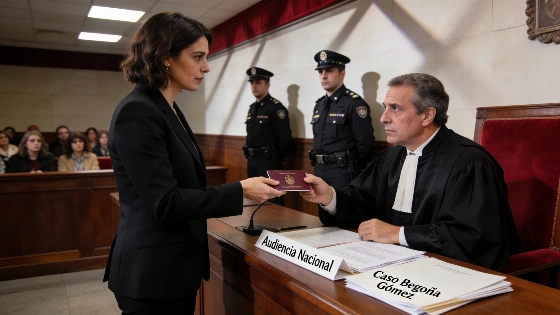
Begoña Gómez, wife of Spain's prime minister, must appear in Madrid to surrender her passport. The court's decision has sparked legal challenges and disciplinary action against the judge. The case highlights tensions within Spain's judiciary.
The legal battle surrounding Begoña Gómez, wife of Prime Minister Pedro Sánchez, intensified this week as Judge Juan Carlos Peinado ordered her to appear at Madrid's Plaza de Castilla court on Wednesday at 18:00 to hand over her passport. This measure, imposed after the court opened oral proceedings against Gómez for alleged influence peddling, business corruption, embezzlement, and misappropriation, has triggered a wave of legal and institutional reactions.
Gómez's defense team has formally appealed the passport seizure, arguing that the measure is unjustified and impractical. They point out that the police officers assigned to her security would make any attempt to flee impossible. The controversy escalated further when the General Council of the Judiciary (CGPJ) initiated disciplinary proceedings against Judge Peinado, after he cited the possibility of Gómez's police escorts facilitating her escape as a reason for the restriction. Despite the judge's assertion that his decision could not be appealed, the defense is seeking to halt not only the passport withdrawal but also the travel ban and the requirement for Gómez to report to court every 15 days.
The case has drawn attention for its political and legal implications. The judge's decision to impose these measures followed requests from popular accusations led by Hazte Oír, which is also seeking a 24-year prison sentence for Gómez. Notably, Judge Peinado had previously rejected similar requests in 2024, deeming them unnecessary and disproportionate at the time, as the investigation was still in its early stages. Now, with the case moving toward trial, the stakes have risen significantly.
Alongside Gómez, her advisor Cristina Álvarez faces similar charges and was also summoned to surrender her passport. However, Álvarez complied ahead of schedule, delivering her passport on Monday. The investigation, which began in April 2024 following a complaint from the group Manos Limpias and was later expanded to include claims from Vox and Hazte Oír, has become one of the most closely watched legal proceedings in Spain. Judge Peinado concluded the investigation last Saturday, stating there was sufficient evidence that Gómez used her relationship with the PSOE leader to advance her career, allegedly with the help of Álvarez. The defense maintains that these accusations lack both objective and subjective legal grounds.
In addition to Gómez and Álvarez, businessman Juan Carlos Barrabés is also facing trial, with a separate case opened against him after the European Public Prosecutor's Office submitted documents raising concerns about a contract awarded to one of his companies. The Madrid Provincial Court has already overturned several of Judge Peinado's previous decisions, including lifting three indictments, excluding the Air Europa bailout from the investigation, and annulling a search of Barrabés's premises. The defense hopes the higher court will once again intervene to block the latest measures.
While Gómez's lawyer cannot directly appeal the order to proceed to trial, the process could be effectively halted if the Provincial Court reverses earlier decisions that enabled Judge Peinado to move forward. The court is still considering whether Gómez should be tried by a jury of citizens or a panel of judges, a proposal opposed by both the defense and the prosecution. Gómez's legal team, led by former Socialist minister Antonio Camacho, continues to seek her acquittal, insisting that the accusations do not meet the necessary legal criteria.
For context, Spain's judicial system allows for popular accusations, enabling groups like Hazte Oír and Manos Limpias to participate in high-profile cases. The ongoing proceedings against Gómez have highlighted divisions within the judiciary and raised questions about the use of precautionary measures in politically sensitive cases. Similar tensions have been observed in other public controversies, such as the recent disciplinary actions in the 'Valle Salvaje' case, where a public punishment sparked debate over judicial conduct.
As the case moves forward, the outcome will be closely watched for its potential impact on Spain's political landscape and the balance of power within its legal institutions. The next steps depend on the decisions of the Madrid Provincial Court, which has already demonstrated its willingness to challenge the lower court's actions.