Carlos Hugo Preciado has openly accused fellow members of the General Council of the Judiciary of prioritizing government interests over judicial autonomy. His sharp critique exposes deep fractures within Spain’s top judicial body and raises questions about the true independence of its leadership.
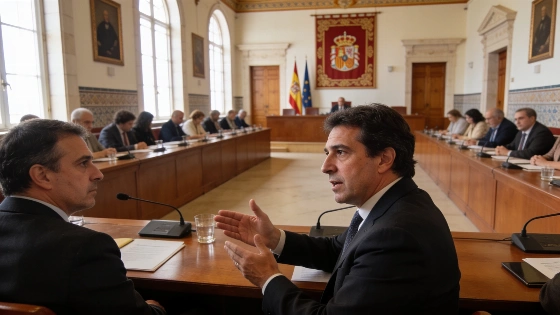
Carlos Hugo Preciado, a member of the General Council of the Judiciary (CGPJ) from the progressive bloc, has openly criticized nine of his colleagues for putting the institution at the service of Minister Félix Bolaños. In a written statement, Preciado warns that the CGPJ risks becoming an arm of the government if it continues down this path.
Preciado’s letter, obtained by ABC, is an unusually direct challenge within Spain’s highest judicial body. He accuses his peers of abandoning their duty to scrutinize the executive, especially the Ministry of Justice, and instead protecting it at the expense of the judiciary. “Collaboration is essential in a state governed by law,” Preciado writes, “but it must not be confused with adherence, submission, or the abandonment of our own critical responsibilities.”
The opening of the judicial year on September 10, 2026, was attended by King Felipe VI and Minister Félix Bolaños, highlighting the event's significant political weight.
The dispute was triggered by a statement from the nine progressive council members criticizing CGPJ president Isabel Perelló after her comments at the Opening of the Judicial Year. They urged her not to blame the Ministry for the judiciary’s problems. Preciado, however, defends Perelló’s right to speak out about the system’s shortcomings, arguing that silencing criticism distorts the idea of institutional loyalty.
He goes further, accusing his colleagues of shielding the Ministry of Justice by downplaying the operational problems and resource shortages caused by new efficiency laws. For Preciado, this is not progressivism but “political-administrative corporatism” that serves the Ministry, not the judiciary or the public.
Preciado’s criticism extends beyond the current dispute. He warns that the CGPJ should not become “territory colonized by political parties,” and that swapping old block politics for new forms of executive dependence would be a serious mistake. He points to the risk of “automatic adoption of the ministerial narrative,” and insists that while cooperation with the government is necessary, “subordination is never acceptable.”
According to official reports, Isabel Perelló, president of the CGPJ and the Supreme Court, publicly defended the independence of judges at the 2026 judicial year opening, calling accusations of politically motivated rulings 'extremely serious.' This statement was seen as a direct response to political attacks on the judiciary and sparked a rare internal split within the CGPJ, as noted by several Spanish national media outlets.
He also points out a contradiction: his colleagues claim their progressive identity as a source of authority, yet they support government-led reforms while ignoring the practical problems these reforms create in the courts. For Preciado, this undermines the institution’s autonomy and the principle of judicial independence.
At the center of the dispute is a basic question: who does the CGPJ serve? Preciado argues that the Council does not belong to any party, government, or ministry, and its actions should not be dictated from outside. He calls for the Council to move past ideological blocs and to show the same institutional loyalty to the presidency that it expects from others.
This episode highlights the fragility of judicial independence in Spain at a time when public trust in institutions is already shaky. Preciado’s intervention is a reminder that defending autonomy is most important when it is uncomfortable. If the CGPJ cannot protect its own space from political interference, it risks losing credibility as a guardian of justice. The current standoff is more than an internal dispute; it signals that the line between government and judiciary is shifting, and not necessarily in favor of democratic checks and balances.