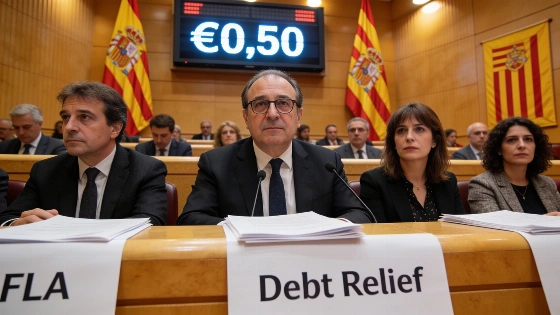
Junts will allow the FLA debt relief bill to proceed in Congress but seeks a higher reduction for Catalonia. The party distances itself from the government, citing unfulfilled agreements. The debate intensifies after the EU court's amnesty ruling.
Junts has agreed to let the Spanish Congress process the government’s proposed law to partially write off the Autonomous Liquidity Fund (FLA) debt, but the party is pushing for a more generous reduction, especially for Catalonia. Jordi Turull, Junts’ secretary general, confirmed the shift on Thursday, stating that the party will use the parliamentary process to negotiate a higher percentage of debt cancellation. He questioned why the current plan limits the write-off and made clear that Junts intends to fight for a larger share for Catalonia.
This move marks a notable change in Junts’ position. When the government first introduced the FLA debt relief proposal in February 2025, party spokesperson Mònica Sales dismissed it as “a joke” and criticized it for perpetuating a “one-size-fits-all” approach. Over the following months, Junts signaled conditional support if the measure came as a decree. Now, the party is prepared to let the bill advance through Congress, aiming to amend it for greater benefit to Catalonia.
The current draft law would see the Spanish state assume €83.25 billion in debt from common-regime autonomous communities, excluding Navarra and the Basque Country. Catalonia stands to have €17.1 billion written off, the second-largest amount after Andalusia’s €18.8 billion. The Community of Valencia and Madrid would also receive significant relief. The bill, under debate since December 2025, cannot pass without Junts’ backing, giving the party leverage to demand changes.
Turull emphasized that the FLA debt issue is a temporary fix, separate from the broader and more complex question of regional financing reform. He insisted that the party’s willingness to negotiate on this law does not signal any warming of relations with Pedro Sánchez’s government. According to Turull, the recent endorsement of the amnesty law by the European Union Court of Justice does not alter the party’s stance, as he accuses the government of failing to honor the agreements that secured Sánchez’s investiture. He stressed that Junts has fulfilled its commitments, while the government has not, and pointed to numerous unresolved issues beyond the amnesty law.
Despite the ongoing negotiations in Congress, Turull described the current legislative term as “failed” and said Junts would continue to approach each issue individually. The party’s critical tone was further underscored on Friday, when Turull publicly rebuked Transport Minister Óscar Puente for urging Carles Puigdemont to return to Spain following the EU court’s amnesty ruling. Turull called Puente’s remarks “misery and frivolity,” responding to the minister’s suggestion that Puigdemont’s return would be a sign of political leadership.
The debate over the FLA debt relief law comes at a time of heightened political tension in Spain, with the government’s relationship with Catalan parties under close scrutiny. The amnesty law, recently backed by the EU court, remains a flashpoint. As highlighted in a related development, Catalan leaders have pressed for immediate implementation of the amnesty, arguing that legal barriers have now fallen—a stance explored in more detail in this recent report on Catalonia’s push for swift amnesty enforcement.
The FLA, created during Spain’s financial crisis, was designed to provide liquidity to regions unable to access markets. Over time, it has become a central issue in debates over fiscal autonomy and regional disparities. The current proposal to write off a portion of this debt is seen as both a financial relief measure and a political bargaining chip. The outcome of Junts’ negotiations could have significant implications for Catalonia’s finances and for the broader debate on Spain’s territorial model.