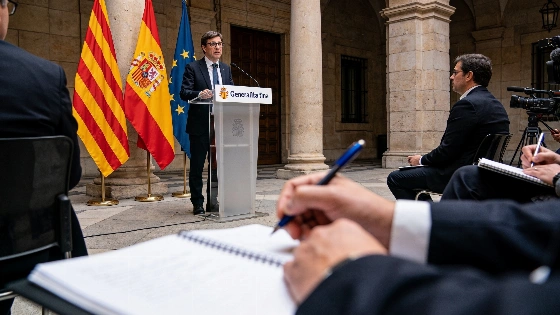
Salvador Illa calls for the amnesty law to be applied without delay after the EU Court's endorsement. The Catalan leader insists there are no more legal obstacles. The move could reshape political participation in Catalonia.
The president of the Generalitat, Salvador Illa, has called for the immediate and uncompromising enforcement of the amnesty law following the European Union Court of Justice's confirmation that the measure aligns with EU law. Speaking from the Palau de la Generalitat, Illa stressed that the court's decision removes any remaining legal uncertainty and leaves no room for hesitation among those responsible for applying the law. He argued that the amnesty is now an integral part of Spain's legal framework and must be implemented in full.
Illa's statement comes after a series of institutional approvals for the amnesty law. The legislation was first passed by an absolute majority in the Spanish Congress, then upheld by the Constitutional Court, and now has received the backing of the EU's highest court. According to Illa, this sequence of endorsements consolidates the law's legitimacy and closes the door on further legal challenges. He addressed his message in Catalan, Spanish, and English, underlining the broad significance of the ruling for both Catalonia and Spain.
The Catalan leader avoided mentioning specific cases or individuals, instead focusing on the broader goal of restoring political and institutional normality. He emphasized that all individuals and political groups affected by the law should be able to participate in Catalonia's future on equal terms, with the same rights and responsibilities. Illa insisted that public authorities must act with respect for the general interest and that the court's decision paves the way for a new phase based on dialogue and coexistence, moving beyond past divisions.
In his address, Illa also linked the normalization of Catalan politics to the region's economic momentum. He highlighted Catalonia's leadership in job creation, investment attraction, public housing development, support for dependent care, and scientific research. For Illa, these achievements demonstrate the benefits of stability and responsible governance, and he urged all parties to look forward rather than dwell on past conflicts.
The debate over judicial independence and political influence has been a recurring theme in Spain, especially in the context of high-profile legal reforms. For example, recent discussions about the pressures faced by the judiciary were explored in detail when the former president of the Supreme Court raised concerns about political interference in judicial matters. This broader context underscores the significance of the EU court's ruling for the ongoing relationship between Spain's legal and political institutions.
The amnesty law, designed to address the fallout from the Catalan independence process, has been one of the most contentious legal measures in recent Spanish history. Its supporters argue that it is essential for reconciliation and democratic normalization, while critics have questioned its compatibility with constitutional and European standards. With the EU Court of Justice's decision, the legal debate appears settled, but the political implications are likely to continue shaping Spain's landscape in the coming months.
For reference, the Tribunal de Justicia de la Unión Europea (TJUE) serves as the highest judicial authority on EU law, ensuring that member states comply with European legal standards. Its rulings are binding and often decisive in resolving disputes over national legislation. The amnesty law's journey through Spain's legislative and judicial system, culminating in this EU-level endorsement, highlights the complex interplay between national sovereignty and European oversight in matters of justice and governance.