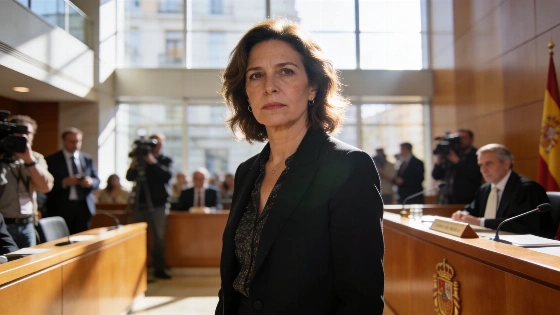
Carlos Lesmes, former head of the Supreme Court, highlights ongoing political pressure on judges. He defends judicial independence as tensions rise over cases involving government figures. The debate intensifies after recent court rulings.
Former Supreme Court president Carlos Lesmes has publicly defended the independence of judge Juan Carlos Peinado, who is currently overseeing the investigation into Begoña Gómez, the wife of Spain’s Prime Minister. Lesmes, speaking at a summer course at Universidad CEU San Pablo in El Escorial, emphasized that despite persistent political pressure, no disciplinary proceedings have been initiated against Peinado. He noted that while there may have been calls for such action, no formal steps have been taken to date.
Lesmes, now chairing the Supreme Court’s Administrative Chamber, reflected on his nine years leading the court, stating that not once was a judge disciplined for political reasons, even though, in his words, politicians frequently push for such measures. He dismissed the notion of coordinated judicial action against the government, calling it unrealistic and highlighting that judges do not conspire or act with political motives.
The debate over judicial independence has intensified following Prime Minister Pedro Sánchez’s public criticism of certain judges. Sánchez, who last year accused Peinado of misconduct, reiterated in a 2025 interview that some judges are acting politically and not upholding the law. This has led to ongoing friction between the government and segments of the judiciary, with accusations of 'lawfare' and claims of a campaign against the Socialist Party and Sánchez himself. The issue escalated further after a Badajoz court sentenced the Prime Minister’s brother to nine years of disqualification from public office, a development that the government has described as politically motivated. For more on the government’s response to this verdict, see the detailed coverage in this related report.
Lesmes also referenced the recent Badajoz case, stressing that judges in regional courts act independently, without instructions from higher judicial bodies or the General Council of the Judiciary. He warned against the growing perception that democratic principles and the rule of law are in conflict, arguing that the will of elected officials should not override the law as interpreted by the courts. According to Lesmes, setting democracy and the rule of law in opposition is a false dichotomy.
Drawing a parallel with international developments, Lesmes cited former U.S. President Donald Trump as an example of political leaders challenging judicial authority. He observed that similar confrontations between political and judicial powers are emerging in Spain and other countries, reflecting a broader trend of tension between branches of government.
Juan Carlos Campo, a former Justice Minister under Sánchez and now a Constitutional Court judge, echoed concerns about the politicization of the judiciary. Campo attributed the phenomenon partly to the slow pace of justice, which he said leads to premature judgments in the media and public opinion. He argued that judges should remain detached from both political and media pressures, and criticized the participation of judges in political talk shows. Campo suggested the creation of a 'judicial spokesperson' role—someone not directly involved in cases—to better inform the public about ongoing legal proceedings.
Spain’s judicial system is structured to ensure independence, with judges appointed through competitive exams and protected from arbitrary removal. The General Council of the Judiciary oversees appointments and discipline, but its own composition has been a point of political contention in recent years. The ongoing debate over judicial independence has practical implications for high-profile cases and public trust in the legal system. As scrutiny of the courts continues, the balance between political accountability and judicial autonomy remains a central issue in Spanish public life.