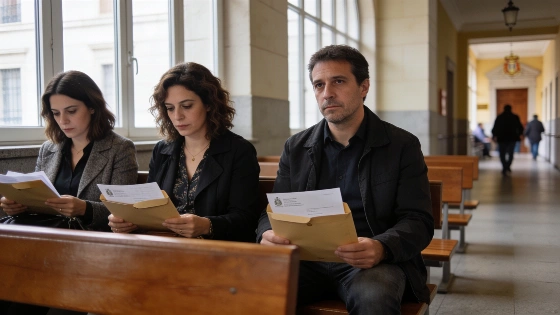
Madrid has drawn 2,846 citizens for possible jury duty in the high-profile trial of Begoña Gómez, wife of the Prime Minister. Only nine will decide her fate, putting Spain’s jury system under the spotlight.
Nine Madrid residents will decide the fate of Begoña Gómez. But the process starts with a list of 2,846 names. Each one could be called to serve in Spain’s most watched trial in years. This time, it’s not just legal experts who will weigh the evidence. Ordinary people will have the final say.
The huge list is deliberate. Madrid’s Provincial Court sent out notifications in September 2024, after a lottery run by the Electoral Census Office. The rules come from the Ley Orgánica 5/1995 del Tribunal del Jurado. The law says the list must be fifty times bigger than the number of jury trials expected in Madrid over the next two years. Everyone on the list is a resident of legal age. Each has now been formally notified of their civic duty. They can also ask to be excluded if they meet certain legal requirements.
Judge Juan Carlos Peinado officially sent Begoña Gómez to a jury trial on September 21, 2026, on charges of influence peddling and embezzlement of public funds.
Getting from 2,846 to the final nine is not simple. For the Gómez trial, a separate draw will pick 36 people from the main list. These 36 can ask to be excused if they have a valid reason—like being over 65, having served on a jury recently, or facing serious family or work issues. The court will hold a hearing to review these requests. At least 20 eligible candidates must remain for the next step.
Once the pool is set, the real test begins. Prosecutors and defense lawyers can question the candidates about almost anything, except their political party ties. Each side gets four vetoes. If there are several parties on either side, they must coordinate their choices. Once the vetoes are used, the next person in line cannot be blocked. When only 11 candidates are left, the jury is set: nine members and two alternates. They will hear the case and decide on the facts in court.
Jurors must act independently and follow the law. Their verdict will answer the questions set by the presiding judge. That verdict will decide if Begoña Gómez is acquitted or convicted. The judge will then write the formal sentence, but the main decision belongs to the jury.
Alongside Begoña Gómez, her assistant Cristina Álvarez has also been sent to trial as a necessary cooperator in the alleged embezzlement episode. The next procedural steps will take place in Madrid's Provincial Court, including the appointment of the jury and preparation for the intermediate phase before the final selection.
Spain’s jury system is not new, but it rarely gets this much attention. The process is open and large in scale. Every candidate gets a certified letter. The system is built on the idea that ordinary people can be trusted to judge serious cases. There are safeguards: people can ask to be excused, and the veto process is tightly controlled to keep things fair.
For those watching how Spanish legal rules change, this case brings back other moments when courts have changed what citizen participation means. As reported earlier, Supreme Court decisions can set new standards for thousands, not just those in the courtroom.
The jury selection for Begoña Gómez’s trial is more than a formality. It is a test of Spain’s promise to let citizens decide big legal questions. The process shows both the strengths and the weak spots of relying on ordinary people in cases that matter to the whole country. As the final nine are chosen, Spain will be watching the process as much as the verdict. This will be a measure of how the country handles fairness, openness, and public trust in its toughest legal fights.