La Bola Negra reaches Spanish cinemas on 25 September 2026 as Spain's submission for the 2027 Oscars. Its story moves from Granada to Cantabria and Sierra Nevada across three periods: 1932, 1937 and 2017.
Granada is the first major setting in La Bola Negra. The film turns its streets and historic buildings into a stage for Federico García Lorca's unfinished work. It reaches cinemas on 25 September 2026 as Spain's submission for the 2027 Oscars. Its three stories follow Carlos in 1932, Sebastián in 1937 during the Civil War and Alberto in 2017. Reports citing the Spanish Film Academy say the film is Spain's official entry in the Best International Feature Film category.
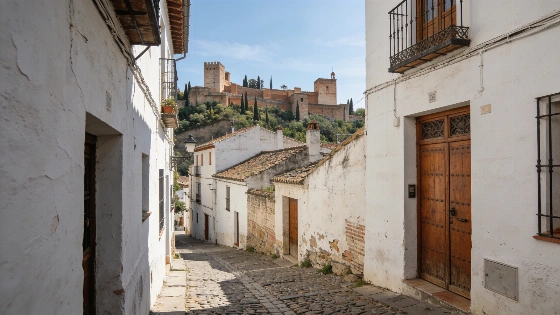
The city is more than a backdrop. The Albaicín, Sacromonte, Plaza Nueva, Plaza de Santa Ana, the Paseo de los Tristes, the Carmen de los Mártires and the Huerta de San Vicente help recreate a Granada connected to the Second Republic.
La Bola Negra was already recognized at Cannes 2026, where its directors received the award for direction.
The film's most revealing choice is the way it rearranges Granada's geography.
Carlos's family home is presented as the Huerta de San Vicente, where Lorca lived and which is now a museum. In the story, Milo Quifes shares the home with Antonio de la Torre, who plays his father, and Natalia de Molina, who plays his sister. The site is almost on the edge of the city. It was not an urban area in the 1930s.
To reach the Casino de Granada, Carlos goes down the slopes of the Albaicín. The route opens onto views that can only be seen from parts of the Sacromonte. The Casino gardens were filmed at the Carmen de los Mártires, where the city spreads out below visitors. Later, Carlos walks with friends along the Paseo de los Tristes beneath La Sabika, the hill where the Alhambra stands.
The film gained further international momentum at TIFF 2026 by winning the People’s Choice Award. That festival response has strengthened its position in the Oscar conversation, although Spain’s selection remains a national submission rather than an Oscar nomination; the film must still pass the Academy’s subsequent shortlist and nomination stages.
The Alhambra mostly stays in the background. It watches over the action rather than taking it over. Sierra Nevada pushes the film's visual geography beyond the city.
Several Albaicín streets needed little more than hidden cables, cleared litter and controlled lighting to suggest the past. Carlos reaches them after a flamenco night and wanders through Granada looking for company. A later revolt linked to the Republic was filmed at Plaza de Santa Ana, near its church. The film keeps the scene's details back to avoid spoilers.
The historical story then moves north. In Comillas, the Seminario Mayor of the Universidad Pontificia became a wartime hospital. There, Sebastián guards Rafael Rodríguez Rapún, secretary of La Barraca and Lorca's former partner. The production also filmed in Valdáliga, Herrerías and the Oyambre area. Those locations were used to recreate a wartime bombing and a fusillade.
Castril de Carrias in Burgos supplied another major setting. The nearly deserted village hosted up to ten days of filming while the art department built false façades and temporary structures. Hundreds of extras from the comarca took part. Local firefighters advised on scenes involving explosions. The village has also appeared in Gernika bajo las bombas, Sacamantecas and Volver a vivir.
La Bola Negra connects these places through three men whose lives are changed by the play that gives the film its title. Lorca left the work unfinished before he was assassinated. Carlos faces exclusion from the Casino because of his homosexuality. Sebastián is drawn into the violence of the Civil War. Alberto inherits from a grandfather who did not know he was still alive.
Each location has a clear job in the story. Granada carries Lorca's memory. Cantabria holds the wartime confinement. Castril de Carrias provides a built landscape made for destruction. Javier Calvo and Javier Ambrossi make geography part of the narrative instead of using it as decoration.
The result is a Spanish film built around the link between place, history and private lives. The Hindu and other international outlets have described it as one of the strongest potential contenders in the 2027 international feature race. They have also noted that wider Oscar recognition still depends on the Academy's formal selection process.