Five years after the Tajogaite eruption, dozens of families are still living in temporary housing. Rising property prices, slow reconstruction and tightly controlled returns continue to prolong the crisis across La Palma.
Five years after the Tajogaite eruption ended, dozens of people in La Palma still live in emergency housing. Around 60 modular and prefabricated homes remain occupied. Reconstruction across the affected area stands at roughly 60%. A shortage of housing is making it harder for families to leave temporary accommodation or rebuild homes destroyed by lava.
The figures show how long the recovery has taken. The eruption began on 19 September 2021 and lasted 85 days, ending on 13 December. Lava covered 1,219 hectares and destroyed 2,988 buildings, including 1,345 homes. About 2,000 residents lost their houses. The disaster also affected 370 hectares of crops and more than 70 kilometres of roads.
Around 1,600 gas sensors now operate in the areas affected by volcanic emissions, transmitting readings in real time to help determine which buildings can safely be used again.
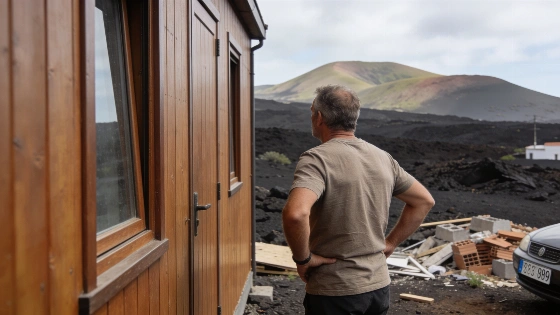
In Los Llanos de Aridane, 39 of the 85 containers installed after the disaster still have residents. Other displaced people remain in the wooden homes in El Paso. These units were meant to provide short-term shelter. Some families have now lived in them for five years.
A new public housing block in Los Llanos is expected to provide 53 homes by December 2026. Authorities plan to give priority to people still living in containers and prefabricated houses. That will not solve every case. Goretti Álvarez says her 97-year-old mother depends on a wheelchair-adapted container. She lives there with another daughter, who provides daily support. They will consider moving only if both women can stay together in a suitable permanent home.
Rebuilding has slowed because there are not enough builders and other skilled workers. Land costs more. Construction materials have become more expensive. Demand has overwhelmed the professionals available on the island. For families who received compensation, the problem goes beyond the amount of money paid. They still need to find a plot and hire workers before they can restore their homes.
The housing programme is intended to extend beyond Los Llanos de Aridane. Plans reported for La Palma include 27 additional homes in El Paso and 16 in Tazacorte, alongside other developments designed to move families out of temporary accommodation.
Compensation has caused another dispute. Juan Fernando Pérez Martín of the Plataforma de Afectados por la Erupción del Volcán Cumbre Vieja 2021 says payments from the central and Canary governments initially arrived slowly. In his case, a private valuation put the value of his adapted home in Todoque at 550,000 euros. The administration used a figure of 374,000 euros. He says the difference leaves him unable to replace what he lost.
The Parliament of the Canary Islands unanimously approved the Ley de Volcanes in September 2025. It is the first Spanish law of its kind. The law aims to provide sufficient aid and speed up economic recovery after a volcanic disaster. Álvarez says the revised compensation system now takes individual circumstances into account more closely. She also says assistance is arriving more fairly.
The property market has moved in the opposite direction. In Los Llanos de Aridane, the average price rose from 1,358 euros per square metre in August 2021 to 2,543 euros in July 2026, according to Idealista. Before the eruption, rents commonly stood at 300 to 400 euros. They now reach about 600 to 800 euros and sometimes exceed 1,000 euros. For families already dealing with displacement, that rise can turn temporary housing into a long-term financial trap.
Some residents of Puerto Naos and La Bombilla still cannot return home. Volcanic gases must be monitored before their properties can reopen. According to local reports, authorities had authorised the return to 1,182 homes in Puerto Naos and 65 in La Bombilla by 15 September 2026. The process depends on safety protocols and continuous gas monitoring. About 1,200 of the 1,250 properties initially evacuated for that reason have been recovered. Reconstruction of the LP-2 road has passed 30% completion and is expected to finish in the first quarter of 2027.
The controlled reopening shows why recovery cannot be judged only by counting repaired buildings. The Cabildo and other authorities use live monitoring to assess individual properties. Local media report that returns are happening gradually, rather than through one decision covering entire neighbourhoods.
Compensation is moving at different speeds. Regional reports say payments have been made for between 881 and 896 primary homes. The difference comes from separate dates and stages of accounting. Roughly half of the second homes and 1,005 agricultural plots have reportedly been compensated. Those categories remain among the main unresolved parts of the claims process.
Regional authorities have also begun asking residents who already received compensation to leave container homes when an alternative is available. If occupants refuse and suitable accommodation exists, the authorities may start an eviction procedure. For families that still cannot buy land or build, compensation does not automatically create a realistic path to permanent housing.
The physical repairs have not erased the psychological damage. Pérez Martín says many affected residents still receive psychological or medical treatment. Álvarez says people on a volcanic island must make prevention part of everyday life. She also argues that emotional recovery needs attention long after the eruption has ended.
La Palma has repaired roads, reopened much of Puerto Naos and started replacing emergency housing. The recovery is still unfinished. The real test is whether displaced residents can find stable homes without being priced out by the crisis that followed the disaster. Five years on, reconstruction is moving forward, while the people who lost the most are still waiting for normal life to become affordable.