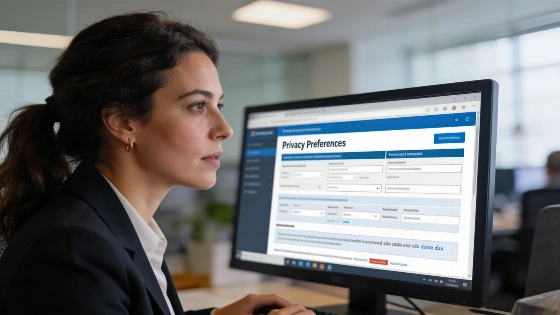
La Voz de Galicia has clarified how it handles personal data. The company now details its use for service delivery and marketing. Users can manage consent for third-party offers and adjust advertising preferences.
La Voz de Galicia, S.A. has introduced updated guidelines on the management of personal data provided by users. The company states that all collected information will be processed to deliver requested services under the existing contractual relationship. Additionally, La Voz de Galicia may send users information about its own products or services based on legitimate interest, unless the user opts out.
For those interested in receiving commercial communications from third-party companies, explicit consent is now required. Users can indicate their preferences regarding such communications, which may be sent electronically or by phone, depending on the data provided. The company emphasizes that personal data will not be shared with third parties unless it is necessary for contract execution or required by law.
La Voz de Galicia also allows users to manage their advertising preferences directly. By deselecting a specific option, users can refuse to receive marketing messages about the company's own products and services. Conversely, by selecting another option, users can agree to receive information about products and services from other companies, including those within the same corporate group.
To further clarify the process, the company provides access to its privacy policy, where users can find detailed information about data processing and instructions on how to exercise their rights regarding data protection. Submission of the relevant form is considered an acknowledgment of the privacy policy and acceptance of the general terms, legal notice, and cookie policy.
Recent changes in data management practices among Spanish media have drawn attention to user consent and transparency. For example, the issue of handling sensitive information has been highlighted in other contexts, such as the urgent transfer of vulnerable minors in Ceuta, where authorities emphasized the importance of privacy and legal compliance. More details on such cases can be found in reports like the coverage of migrant minors' relocation from Ceuta to mainland Spain.
In Spain, data protection regulations are governed by both national law and the European Union's General Data Protection Regulation (GDPR). Companies are required to inform users about the purposes of data collection, obtain consent for marketing, and provide clear mechanisms for managing preferences. These measures aim to strengthen user control and ensure compliance with evolving privacy standards across the country.