Laura Olcina, head of ITI, has received Spain’s top innovation award for her leadership and nearly three decades of work. Her approach challenges traditional barriers in the tech sector and highlights gaps in digital transformation.
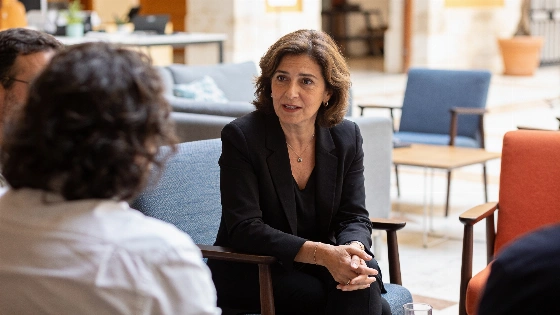
Laura Olcina, director of the ITI technology center in Valencia, has been awarded the 2026 National Innovation Award for her career and leadership in the Spanish tech sector. The recognition comes as ITI, under her guidance, has grown from a small team to an organization with over 350 professionals and annual revenues exceeding €20 million. Olcina’s management style stands out for its emphasis on accessibility and trust, replacing the usual formal barriers with open conversation and collaboration.
Olcina’s journey at ITI began in 1998 as an intern. By 29, she was leading the center, which at the time had fewer than ten employees. Today, ITI operates across several locations, including Paterna, the Universitat Politècnica de València, and Torre Juana in Alicante. The award recognizes not only her achievements but also her resilience through setbacks, such as a failed early venture into facial recognition technology and navigating financial crises that once forced the center into temporary layoffs.
Her experience with early facial recognition projects between 2005 and 2007, which found interest abroad but not in Spain, shaped her approach to innovation. Olcina now insists that true transformation only occurs when technology changes business processes or models, not just digitizes paperwork. She also argues that innovation must have lasting impact, not disappear once public funding ends.
Beyond ITI, Olcina leads the Spanish Federation of Technology Centers (FEDIT), representing 56 centers and over 11,000 professionals. She also chairs the Advisory Council for Science, Technology and Innovation (CACTI) and sits on the board of the CDTI. Olcina uses these roles to advocate for tailored public policies, emphasizing that not all organizations have the same needs or starting points. She points to FEDIT’s data showing that every euro invested in technology centers generates €11 in income and €26.4 in sales, underlining the sector’s economic impact.
Olcina is currently working on a doctoral thesis on artificial intelligence and remains critical of claims that Spanish companies have widely adopted AI. She estimates real adoption at around 20%, with significant regional and sectoral differences. While the Valencian Community performs above average, she warns that local innovation often attracts more attention abroad than at home. In some cases, Valencian firms have acquired ITI-developed technology through foreign intermediaries, highlighting a disconnect within the ecosystem.
She believes that Spanish and Valencian organizations must look beyond local competition and recognize the global landscape dominated by the US and China. For Olcina, Europe must identify strategic areas where it can excel and avoid one-sided dependencies, especially in digital and defense technologies. ITI has already applied its AI and 5G developments to defense, focusing on reducing vulnerabilities rather than simply securing funding.
Talent remains a major challenge. Women make up 28% of ITI’s staff, a figure that, while low, is high compared to the 12–13% of female computer engineering graduates. Olcina admits she did not initially see gender inequality as a barrier, feeling more out of place as an economist among engineers. Over time, she recognized the importance of visible female role models and now ensures that ITI’s outreach includes women trainers to show that technology is not a male-only field.
Her leadership philosophy is summed up by a sign in her office: “More Lego, less ego.” Olcina sees herself as one piece in a larger structure, relying on technical experts, delegating, and building collaboratively. She avoids public criticism of authorities, preferring to address issues directly and propose solutions. Despite offers to enter politics, she has chosen to remain independent, believing she can contribute more by connecting public, private, and academic sectors.
The award comes after years of unpaid responsibilities, travel, and the pressure of managing a large organization without guaranteed funding. For Olcina, the recognition is a validation of her efforts but not the end of her journey. She sees it as motivation to continue driving change in Spain’s tech landscape. Her story echoes broader debates about innovation and leadership, similar to how local leaders in other regions, such as Vigo’s mayor seeking to elevate the city’s cultural profile, have challenged established norms—see the example of Vigo’s push for a bigger stage for international artists.
Spain’s technology sector continues to face challenges in scaling innovation, retaining talent, and bridging gaps between research and industry. The country’s network of technology centers plays a crucial role in supporting businesses, fostering collaboration, and driving economic growth. As digital transformation accelerates, the need for effective leadership and inclusive policies becomes even more pressing. Olcina’s recognition highlights both the progress made and the work still ahead for Spain to fully realize its innovation potential.