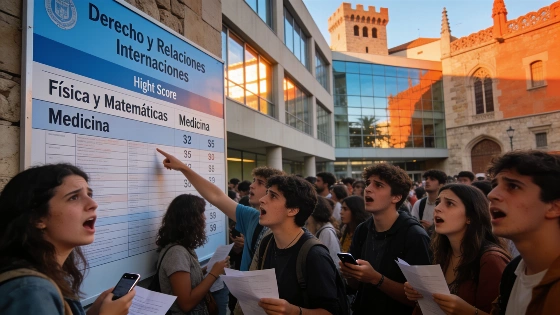
The University Autónoma de Barcelona’s Law and International Relations double degree now leads Catalonia’s university cut-off rankings. Physics, Mathematics, and Medicine have all seen notable drops in required scores. Admission trends are shifting.
The University Autónoma de Barcelona (UAB) has claimed the top spot in Catalonia’s university admission rankings, with its double degree in Derecho y Relaciones Internaciones now requiring a cut-off score of 12.972. This marks a significant change after years of dominance by the double degree in Física y Matemáticas, which has now been overtaken following a notable shift in application trends and score requirements.
The latest data, released by the Department of Universities after the first round of seat allocations, shows that the Derecho y Relaciones Internaciones program at UAB increased its cut-off by two tenths, while traditional leaders such as Física y Matemáticas and Medicina experienced declines. At UAB, Física y Matemáticas now requires a 12.924, and at the University of Barcelona (UB), the same program stands at 12.812—both down by about three tenths compared to last year. Engineering in Aerospace Technologies at UPC follows with a 12.694, also three tenths lower, while Medicine at UB’s Campus Clínic dropped to 12.684, and Mathematics at UPC now sits at 12.552, one tenth less than before.
This reshuffling in the rankings reflects broader changes in student preferences and the competitive landscape of Catalan higher education. The Department of Universities published the new cut-off scores for all seven public universities in Catalonia, as well as the University of Vic, highlighting a general downward trend in the most competitive science and medical degrees. The rise of the Law and International Relations double degree signals a shift in demand, possibly influenced by evolving job market expectations and the perceived versatility of combined legal and international studies.
For many families and prospective students, these changes have practical implications. A higher cut-off for Derecho y Relaciones Internaciones means increased competition for a place in this program, while the lower thresholds for science and medical degrees may open doors for applicants who previously fell just short. The annual publication of cut-off scores is closely watched across Catalonia, as it directly affects university access and career planning for thousands of young people.
Admission cut-offs are recalculated each year based on the number of applicants and available places, making them a sensitive indicator of both academic trends and broader social shifts. The current adjustment comes at a time when Catalonia’s universities are also responding to demographic changes and evolving educational priorities. For context, recent shifts in regional priorities have also been observed in other sectors, such as the political landscape, where far-right parties have made significant gains in the Catalan Parliament, reflecting a broader pattern of change in the region.
Understanding the significance of these cut-off scores is essential for students navigating the admissions process. In Spain, university access is determined by a combination of high school grades and results from the national university entrance exam (EBAU or Selectividad). Each degree program sets its own cut-off, which fluctuates annually depending on demand and capacity. The prominence of the Derecho y Relaciones Internaciones double degree this year may indicate a growing interest in interdisciplinary studies that combine legal expertise with global affairs. Meanwhile, the decline in science and medical cut-offs could be temporary or may signal a longer-term adjustment in student priorities. As universities continue to adapt to changing applicant profiles, the annual cut-off rankings remain a key reference point for educational planning in Catalonia.