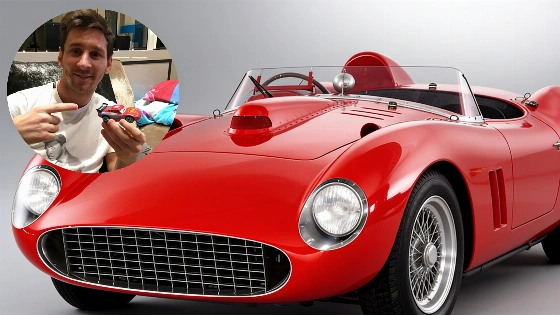
In 2016, a record-breaking Ferrari auction in Paris set off speculation that Leo Messi had bought the iconic 335 Sport Scaglietti for over €32 million. The real story reveals how a single rumor can capture global attention—and why the truth was far more nuanced.
When a 1957 Ferrari 335 Sport Scaglietti sold for €32.1 million at the 2016 Rétromobile Paris auction, the automotive world took notice. The staggering price set a new benchmark for classic car sales, but it was the rumor swirling around the buyer’s identity that truly electrified headlines: had Leo Messi, then at the peak of his career with FC Barcelona, really acquired one of the rarest Ferraris ever built?
The auction, organized by Artcurial, featured over 130 classic vehicles, including 19 Ferraris. Yet it was lot 170—the 335 Sport Scaglietti—that drew the fiercest bidding. Starting at €20 million, the price quickly escalated as collectors vied for a piece of racing history. The final hammer fell at €32.1 million, surpassing the previous record held by a Ferrari 250 GTO since 2014.
Speculation about the buyer’s identity intensified almost immediately. Reports suggested Messi had outbid none other than Cristiano Ronaldo, adding a layer of rivalry to the story. The idea of two football icons battling for a legendary car was irresistible to fans and media alike. However, Messi is not known for an extensive car collection, and the rumors soon spiraled beyond what the facts could support.
Messi himself addressed the speculation with characteristic humor. On Instagram, he posted a photo holding a miniature Rayo McQueen toy car, captioned, “The new car they say I bought.” The playful denial put an end to the wild theories, but not before the story had made its rounds across social media and news outlets.
The Ferrari That Fueled the Frenzy
The Ferrari 335 Sport Scaglietti is a cornerstone of the brand’s racing legacy. Built in 1957 for the World Sportscar Championship, only four units were ever produced, making it one of the most exclusive competition Ferraris. Its engineering was a direct response to the fierce rivalry with Maserati, featuring a 4.0-liter V12 engine capable of 400 horsepower and a top speed of 300 km/h—remarkable figures for its era.
Chassis 0674, the car sold in Paris, debuted at the 12 Hours of Sebring and later finished second at the Mille Miglia, driven by Wolfgang von Trips under team orders. It also competed at the 24 Hours of Le Mans, where Mike Hawthorn set a lap record before mechanical failure forced retirement. The car’s racing pedigree includes a victory at the Cuban Grand Prix with Stirling Moss and Masten Gregory behind the wheel, and it contributed to Ferrari’s 1957 world constructors’ title.
After its racing career, the 335 Sport Scaglietti passed through very few hands. In 1970, it was acquired by Pierre Bardinon, a renowned Ferrari collector, and remained in his private collection for over forty years. Its impeccable provenance and limited production only increased its allure among collectors.
Rumors, Rivalries, and Reality
The notion that Messi and Ronaldo were locked in a bidding war for the Ferrari was never substantiated, but it captured the imagination of fans worldwide. The story’s viral spread highlights how quickly speculation can overshadow fact, especially when it involves global celebrities and record-breaking sums. As noted in a recent analysis of high-profile car acquisitions, such as José Mourinho’s choice of the BMW XM for Real Madrid, the intersection of sports fame and luxury vehicles continues to fascinate audiences (see more on Mourinho’s automotive statement).
Ultimately, Messi’s public denial brought the saga to a close, but the episode remains a case study in how rumors can shape the narrative around major auctions. The Ferrari 335 Sport Scaglietti’s sale stands as a milestone in the collector car world, while the myth of Messi’s involvement endures as a reminder of the power—and pitfalls—of celebrity speculation.
Context and Legacy
Today, the 335 Sport Scaglietti is recognized not only for its engineering and racing history but also for its role in one of the most talked-about auctions of the decade. The car’s value reflects both its rarity and the stories attached to it. For collectors, provenance and legend are often as important as performance. For the public, the allure of seeing sports icons linked to such treasures ensures these tales will continue to resonate long after the gavel falls.