Leonardo Marcos rejects claims he told Guardia Civil agents to ease off the investigation into Prime Minister Pedro Sánchez’s brother. The National Court is looking into allegations of internal pressure and political interference, exposing tensions at the top of Spain’s law enforcement.
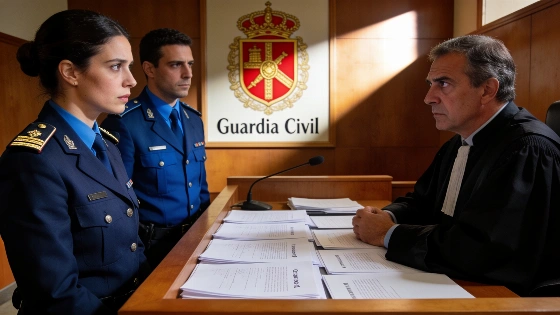
Leonardo Marcos, former director general of the Guardia Civil, appeared before Spain’s National Court in Madrid to answer accusations that he pressured investigators to step back from a corruption probe involving Prime Minister Pedro Sánchez’s brother. The case has put the integrity of Spain’s law enforcement and the government’s handling of internal investigations under close scrutiny.
The controversy centers on the so-called Leire Díez case, a judicial investigation into an alleged scheme by former socialist activist Leire Díez and ex-PSOE secretary Santos Cerdán. The case focuses on attempts to disrupt judicial proceedings that could harm the ruling party. According to the case file, the plan involved seeking compromising information on officials and encouraging internal probes within the Guardia Civil to intimidate investigators. Reports from EFE and other Spanish agencies say the court is examining whether there was a coordinated effort to discredit cases affecting PSOE and the government, including attempts to gather damaging material on public officials and investigators.
On September 10, 2026, Leonardo Marcos testified as a suspect in the Leire Díez case, denying pressure on the UCO but admitting he asked for the report on David Sánchez to be completed quickly.
Marcos, who led the Guardia Civil from June 2023 to September 2024, appeared before Judge Santiago Pedraz to address claims that he told the Unidad Central Operativa (UCO) to take a passive approach in the investigation of David Sánchez, the prime minister’s brother. David Sánchez was recently convicted by the Provincial Court of Badajoz for irregularities related to his appointment at the Diputación de Badajoz and received a nine-year disqualification penalty, according to court documents and national media coverage.
During his testimony, Marcos denied trying to influence the UCO’s work. He said his only concern was whether information was leaking from inside the Guardia Civil, not the direction or intensity of the investigation. His statement matches denials from his successor, Mercedes González, and the institution’s operational deputy, Manuel Llamas, who also appeared as suspects and rejected claims of pressuring subordinates. According to EFE, these testimonies are part of a broader process in which several top officials, including the current head of the Guardia Civil and a PSOE manager, have been called to testify before Judge Pedraz in early September 2026.
The accusations against Marcos gained traction after senior UCO officers, generals Rafael Yuste and Alfonso López Malo, reported that in a summer 2024 meeting, they were told to avoid proactive action in politically sensitive cases. They described the guidance as generic and not aimed at any specific party, but recalled a separate incident where Marcos was angry over UCO agents’ proposal to a judge to access emails from the Diputación de Badajoz as part of the Sánchez investigation. Rafael Yuste’s testimony has been cited as a key source of the allegations, with reports indicating he claimed both Marcos and deputy chief Manuel Llamas asked the UCO to "stay aside" in the case involving the prime minister’s brother.
The investigation into the Leire Díez case also examines alleged payments totaling 43,225 euros, which, according to the prosecution, were funneled through intermediaries linked to former PSOE leadership. This financial angle is being scrutinized alongside claims of coordinated actions to influence or discredit judicial proceedings.
The Partido Popular (PP) played a central role in bringing Marcos before the court, arguing that the timing of internal communications and the opening of confidential inquiries pointed to coordinated action at the top of the Guardia Civil. The PP’s submission to Judge Pedraz emphasized that Marcos, as director general during the relevant period, bore ultimate responsibility for any such coordination. According to El Mundo and other major outlets, the political fallout has already begun, with opposition parties demanding explanations and the Tribunal de Cuentas issuing new deadlines and orders related to the Badajoz and PSOE-linked episodes.
These developments follow earlier reports about financial flows and internal maneuvering in the Leire Díez case, as covered previously. The investigation has now widened to look at both the alleged plot to undermine judicial processes and the internal climate within Spain’s top law enforcement agency.
The case has exposed deep institutional friction, with senior officers caught between political expectations and the demands of judicial independence. The National Court’s decision to question top officials is unusual and signals a rare moment of accountability at the intersection of politics and policing. While Marcos and his colleagues have denied wrongdoing, the pattern of complaints and the timing of internal actions point to a culture where political sensitivity can override operational autonomy. The outcome will test how far political influence reaches into Spain’s security institutions and whether the system can withstand it.