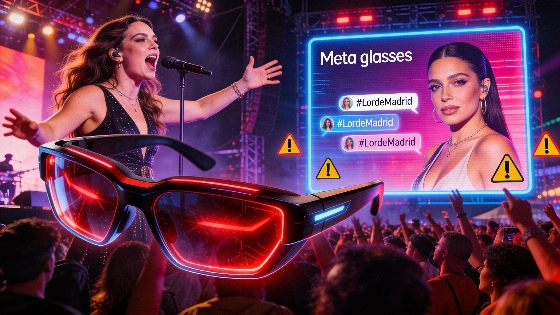
Lorde publicly denounced AI-powered glasses at a Madrid festival. Meanwhile, Kylie Jenner's collaboration with Meta on smart eyewear has triggered a wave of criticism over privacy and surveillance risks.
Sharp criticism of AI-powered smart glasses has erupted after Lorde used her performance at Madrid's Mad Cool Festival to openly reject the technology. The singer interrupted her set to warn the audience about the growing difficulty of distinguishing reality from artificiality, urging fans to avoid the new glasses and calling them unappealing. Her remarks quickly resonated, highlighting a broader unease around wearable AI devices.
The debate intensified as Kylie Jenner, one of the world's most influential celebrities, faced mounting backlash for her partnership with Meta to launch a line of AI-enabled smart glasses. The product, promoted with features like a built-in camera, hands-free recording, and an AI assistant mimicking Jenner's voice, has drawn sharp reactions online. Promotional campaigns, including appearances by Kris Jenner, have not softened criticism. Many social media users have voiced alarm over the potential for these glasses to be used for covert recording in public spaces, especially targeting women without their consent. Some described the campaign as disconnected from reality, while others compared the ads to dystopian scenarios.
Jenner's own history with privacy has fueled the controversy. In a recent podcast, she recalled being persistently photographed by paparazzi as a teenager in Los Angeles, describing the experience as intimidating and invasive. Critics now point to this background as contradictory to her current role in promoting wearable cameras. Consent educators and gender justice advocates argue that such technology could exacerbate issues of surveillance and harassment, disproportionately affecting women. They also emphasize that responsibility should not rest solely on users, but on the companies profiting from these products.
Meta, when approached for comment, declined interviews and instead referenced a statement about the glasses' safety features. The company highlighted a visible LED light that activates during recording, intended to alert bystanders when content is being captured. Meta noted that, unlike many mobile devices, this indicator has been present since the product's launch. However, this measure has not quelled concerns about misuse or the adequacy of safeguards.
Pressure on Meta has grown in recent weeks. The company recently withdrew a feature that would have allowed users to generate AI content using public accounts, following objections from major Hollywood agencies and unions. Industry representatives stressed that personal likeness and creative work should not be used without explicit consent. Meta acknowledged the criticism and confirmed the feature's removal.
Wearable AI technology, particularly smart glasses, remains a contentious topic as companies push for broader adoption. In Spain and across Europe, privacy regulations are among the strictest in the world, with authorities closely monitoring the impact of new surveillance tools. The controversy surrounding Meta's glasses and high-profile endorsements like Jenner's may influence future regulatory discussions and public acceptance. As the debate continues, the balance between innovation and privacy remains unresolved, with both consumers and policymakers watching developments closely.