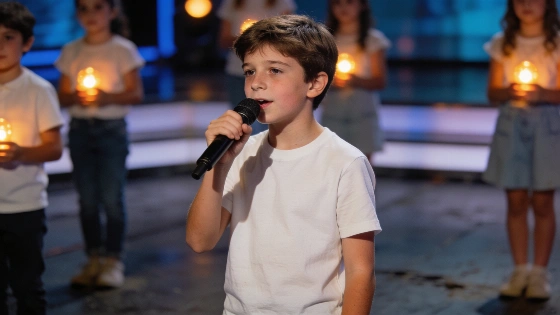
RTVE has unveiled Spain's entry for Junior Eurovision 2026. Ten-year-old Lucas Paulano will perform a ballad about love, memory and the people who stay with us.
The song will reach the Junior Eurovision stage in Ta' Qali on 24 October. RTVE has chosen ten-year-old Lucas Paulano to perform "Cuore Bello (Te quiero, te quiero)" in Malta. The broadcaster has also released the official video and its presentation materials.
Lucas helped write the song with Blas Cantó, Dangelo Ortega and Carlos Almazán. That gives him a direct hand in Spain's entry. RTVE materials and independent Eurovision industry coverage confirm the date and venue.
Before his Junior Eurovision selection, Lucas Paulano was identified in Spanish media as the winner of La Voz Kids 2025, a result that helped establish his profile as a young performer.
Its idea reaches beyond romance.
"Cuore Bello (Te quiero, te quiero)" treats memory as part of personal identity. The song turns to people and moments that remain in the heart over time. RTVE carries that idea through the music and the video. Independent coverage describes the track in similar terms. It is about memories and the people who leave a lasting mark, not only romantic love.
Lucas has called the track beautiful. He said he wants the chorus to make people feel happy and sing along in the street.
César Vallejo, head of the Spanish delegation, described the entry as a message about love and union with memories. He also recalled Lucas's performance during two in-person casting sessions in Madrid. The boy stood out for his voice and personality.
María Eizaguirre, RTVE's director of Communication and Participation, pointed to Lucas's singing, movement and connection with the camera.
The song and video were presented at an RTVE studio in Prado del Rey on 28 September, with the release scheduled for broadcast and online publication on the same day. Reports from the presentation identified Lucas Paulano, Blas Cantó, María Eizaguirre, César Vallejo and Sergio Calderón among those involved in the public launch.
The Malta performance is still taking shape. Javier Pageo will oversee the staging after working on Sandra Valero's 2023 performance. Verónica Ferreiro is the vocal coach. Raúl Amor is handling styling and costumes.
The music team wants to keep the character of a classic ballad while giving it a more current finish. RTVE's making-of materials place those roles within the wider preparation for Malta.
Blas Cantó has praised Lucas's confidence in the studio and his ability to follow creative direction. Dangelo Ortega said the song's strength comes from the balance between its traditional essence and its contemporary touch. The vocal performance remains at the centre.
The video takes the memory theme further. Jimmy Llamas directed it. He also made Spain's three latest Junior Eurovision videos. The entire shoot took place on a set built around childhood and memories.
A bedroom filled with postcards, toys, miniature planes, a carousel and other objects creates a familiar space. The most personal prop is Dudú, the stuffed rabbit that has been with Lucas since birth.
Light carries the visual story. Dancers hold points of light that represent memories. They gradually bring those memories to life, and Lucas is eventually surrounded by them.
Twenty-two children appear in the scenes. A young pianist joins them, along with Marcos, Lucas's brother, on violin. The video also includes clues about elements that may appear in Malta. RTVE has not said that the final staging is complete.
An earlier report on a major Spanish television production showed a music-led visual approach. Lucas's entry works on a smaller, more personal scale. The song, video and performer's age all support the same idea. Memory is the organising principle.
RTVE has also recorded a symphonic version with the Orquesta y Coro de RTVE at the Teatro Monumental. It will be broadcast soon.
Tony Aguilar and Julia Varela will commentate on the contest in Spain. Víctor Escudero will serve as adviser. Lucas's role as singer and co-writer gives the entry a clear focus. It relies on interpretation rather than noise.