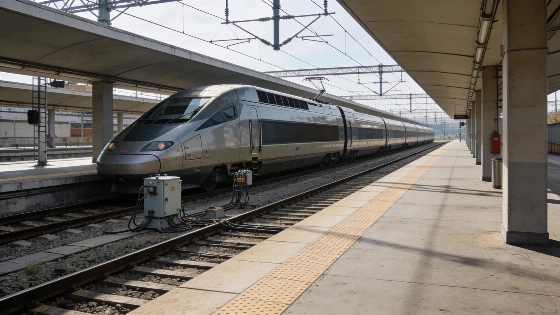
High speed rail service between Madrid and Barcelona restarted after a two-hour suspension caused by storm damage to overhead lines. Delays and cancellations affected both trains and flights throughout Catalonia.
Travel across Catalonia came to a standstill on Wednesday when a violent storm forced Adif to halt all high speed trains between Madrid and Barcelona for two hours. The stoppage, caused by a failure in the overhead power lines near Sant Vicenç dels Horts, left passengers stranded and threw schedules into chaos. By early afternoon, Adif announced repairs were finished and trains could run again, but delays continued to pile up.
The trouble started just after 11:00, when Adif detected a major power supply problem on the Madrid–Barcelona high speed line. The fault, directly linked to the severe weather sweeping the region, cut electricity between Sant Vicenç dels Horts and El Prat de Llobregat. Adif teams worked quickly to restore service, while the Ministry of Transport warned that delays could get worse if the repairs took longer. Even before the full shutdown, Adif had reported electrical issues as early as 8:15, setting the stage for a day of travel problems.
According to Spain's Ministry of Transport, only a single track was operational on the Madrid–Barcelona corridor due to storm damage to the overhead line in Sant Vicenç dels Horts, which led to increased delays during peak hours.
When the line reopened at 12:48, the situation was still far from normal. Trains leaving Madrid could only go as far as Zaragoza, while those departing Barcelona faced immediate delays. Services heading to Barcelona were held at intermediate stations, adding to the confusion. Average delays reached up to an hour, and Adif warned that it would take time to get back to normal. According to the company, this is not an isolated case: this week alone, there are 81 temporary speed restrictions across Spain's high speed network, with nearly half on the Madrid–Barcelona–French border corridor. In some areas, trains are limited to 30 km/h, a fraction of their usual speed.
Commuter trains were also hit. Rodalies users in Catalonia, already used to service interruptions, faced new delays on the R2 line because of a signaling fault between Sitges and Vilanova i la Geltrú. A cable theft between Vila-seca and Reus in Tarragona caused further problems for trains on the Tarragona–Reus stretch. These incidents show how fragile Catalonia's rail infrastructure can be, especially during bad weather.
The storm also disrupted air travel. At Josep Tarradellas Barcelona-El Prat airport, 30 flights were cancelled and two diverted to Madrid by early morning. With more than 1,000 flights scheduled for the day, Aena reported a slow recovery but warned that more disruptions could follow if the rain continued. Air traffic control agency Enaire increased the spacing between planes, citing the difficulty of landing in the storm.
On the same day, the Rodalies R2 commuter line suffered from a signaling issue between Sitges and Vilanova i la Geltrú, while a separate cable theft between Vila-seca and Reus in Tarragona caused further delays on southern regional trains. These incidents compounded the disruption across Catalonia's rail network.
Authorities responded by restricting movement in the hardest-hit areas. The Generalitat ordered remote work and suspended outdoor school and sports activities in Baix Llobregat, Vallès Occidental, Garraf, and both Alt and Baix Penedès. These steps aimed to reduce risk as heavy rain continued to threaten public safety.
Recent weather has repeatedly tested Catalonia's infrastructure. As reported earlier, storms have brought both relief from heat and new challenges for transport and daily life in Barcelona and nearby areas.
Spain's high speed rail system, once seen as highly reliable, now faces growing criticism as technical failures and weather-related incidents become more common. The events in Catalonia highlight how vulnerable key infrastructure is to extreme weather and point to the need for greater investment in resilience. Until these weaknesses are addressed, passengers will keep facing disruptions every time a storm hits, and confidence in smooth travel will remain shaky.