A 60-million-euro wave pool near the Metropolitano stadium has sparked protests in Madrid. Residents and environmentalists warn of excessive water use and legal uncertainty. The project is set to open in 2027 despite a court ruling.
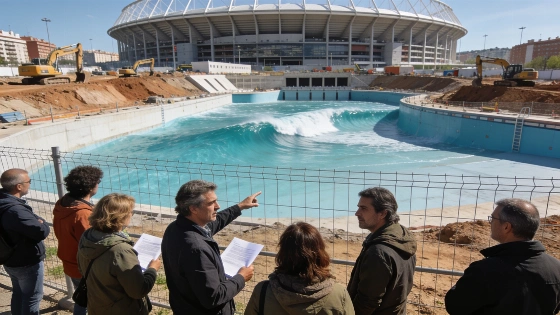
The construction of Europe’s largest artificial wave pool in Madrid’s San Blas-Canillejas district has ignited a fierce dispute over water consumption, legal status, and the use of public funds. The 23,000-square-metre facility, set to open in 2027 next to the Metropolitano stadium, will require 30,000 cubic metres of potable water and is expected to lose more water to evaporation each year than its total capacity, according to environmental groups.
Local residents and environmentalists have voiced strong opposition, highlighting that the pool’s annual evaporation could reach 32,200 cubic metres—exceeding the lagoon’s volume by 7%. In summer, daily evaporation may hit 184,000 litres. The project, which includes a 5,500-square-metre artificial beach, hotel, and restaurants, is funded in part by 15.7 million euros from the European Union’s Next Generation funds, earmarked for sustainable tourism. Critics argue that the complex will increase traffic, noise, and strain on local infrastructure, while also pointing out that Spanish regulations prohibit the use of recycled water for recreational purposes, forcing reliance on potable supplies.
Legal uncertainty surrounds the development after a court annulled the special urban plan that allowed the land transfer to Atlético de Madrid. While the city council has appealed, the court’s decision cited the lack of an environmental impact assessment as a key reason for the annulment. Despite this, construction continues, as no injunction was requested to halt the works. Project promoters, Gemswell Surf Madrid, maintain that the pool is not affected by the ruling, but city planning records indicate otherwise.
The project’s backers, including Buenavista Infrastructure and the European Investment Bank, insist all funding criteria have been met and that technical measures—such as advanced waterproofing, drainage systems, and splash barriers—will minimize water loss. The Ministry of Economy states that if the annulment is upheld, a detailed study will determine the site’s future. Atlético de Madrid claims the court ruling does not reference the need for a strategic environmental assessment, though the judgment repeatedly addresses this requirement.
Neighbourhood associations, such as Las Musas – Las Rosas, fear the area will become a commercial hub rather than a sports centre, with concerns over parking shortages and increased congestion. Residents recall promises of a major public sports facility and a metropolitan forest, but now face more urban challenges than those living in central Madrid. Political opposition in the city council has also criticized the project, calling for more public water facilities and questioning the focus on large-scale private developments. Socialist councillor Antonio Giraldo points out that Madrid has only 25 public pools for 3.5 million people, arguing that public investment should prioritize accessible solutions.
For context, large-scale entertainment projects in Spain have previously generated debate over their economic and environmental impact. For example, the arrival of major international productions, such as Disney’s filming in Alicante, has brought significant investment to regions like Valencia, as reported in this coverage of Ciudad de la Luz’s transformation. However, the Madrid wave pool case highlights the growing tension between urban development, environmental sustainability, and the expectations of local communities.
Spain’s ongoing drought and water scarcity issues add further complexity to the debate. The country has faced repeated calls to improve water management and prioritize sustainable tourism. The controversy in San Blas-Canillejas underscores the challenges of balancing economic development with environmental responsibility and local needs, especially as climate pressures intensify across the Iberian Peninsula.