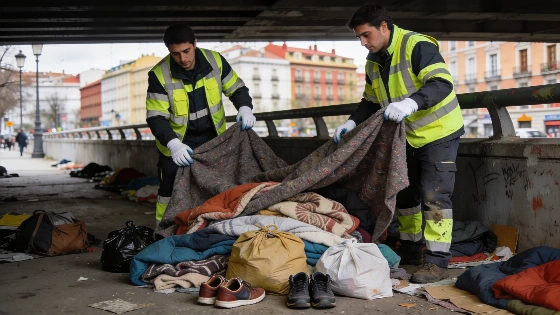
Madrid’s shelters are overwhelmed, with 842 homeless people waiting for a place. City officials have instructed staff not to use the term 'waiting list.' Most applicants may never get a bed.
Madrid’s municipal shelters are under intense scrutiny as 842 people living on the streets remain in limbo, waiting for a chance to access city accommodation. Some have been on these lists since 2022, yet a recent directive has instructed staff not to refer to these queues as a 'waiting list.' Instead, workers are told to say individuals are 'pending access or assignment of a place according to their needs.' This change, recorded in a July 7 meeting, has sparked frustration among frontline staff, who argue that the majority of those waiting will never secure a spot.
According to staff managing the process, the system does not prioritize those who have waited the longest. Instead, entry is based on an assessment of vulnerability, with the Puerta Única de Entrada (PUE)—a team of four—making the final decision. The PUE oversees 1,222 shelter places, but with demand far outstripping supply, many applicants are left without hope of accommodation. Workers describe the official list as misleading, noting that only names written on a physical board at the Pedro Meca center are likely to be offered a place. They say that offering shelter to people on the street often feels disingenuous, as most will never be housed.
City officials deny any new instructions have been issued, insisting that individualized assessments are standard practice and that a single waiting list would 'dehumanize' the process. A spokesperson for the Social Policy area emphasized that places are not assigned by waiting time but by the urgency of each case. Vulnerable groups, such as women at risk of sexual violence, those recently discharged from hospital, or people with mental health diagnoses, are prioritized. However, even these criteria do not guarantee immediate access, only a chance to be considered for the real, unofficial list.
The issue has become a flashpoint in local politics. Más Madrid raised the matter at a recent Social Policy Commission, but the area delegate did not respond directly. Instead, the director general of Social Inclusion, Laura Castaño, denied that belongings of homeless people were being discarded and suggested that recent reports stemmed from labor disputes with the subcontractor managing the service. This response prompted a letter from street outreach teams, accusing Castaño of downplaying their concerns and misrepresenting the reality faced by those on the ground.
Political tensions have escalated, with Más Madrid’s spokesperson, Rita Maestre, accusing the city government of hiding the true scale of the problem by refusing to acknowledge the number of people waiting for shelter. She argued that the administration is deliberately avoiding transparency to escape accountability for the hundreds left outside the system.
Madrid’s approach to homelessness is not unique in Spain. Across the country, social services are under pressure, with rising demand and limited resources. In Andalusia, for example, recent changes to mental health care have also drawn criticism for leaving vulnerable groups without adequate support. For more on how regional policies are affecting access to care, see this report on Andalusia’s mental health plan and its impact on families.
Spain’s major cities have struggled for years to balance limited shelter capacity with growing numbers of people experiencing homelessness. According to national data, the number of people living without stable housing has increased steadily over the past decade, driven by economic pressures, housing shortages, and gaps in mental health and addiction services. While Madrid’s officials defend their individualized approach, critics argue that the lack of transparency and the refusal to acknowledge waiting lists make it harder to address the underlying crisis. The debate highlights the ongoing challenge of providing effective, humane support for some of the city’s most vulnerable residents.