The Koordinadora de Familias por la Educación Pública has asked Spain’s ombudsman, Ángel Gabilondo, to examine whether Madrid’s regional administration is adequately protecting the constitutional right to education during the teachers’ strike. The indefinite action began on 14 October 2026 and involves teachers in early-years and school education, as well as vocational training.
The platform has also formally requested a meeting with Mercedes Zarzalejo, the regional education councillor, to convey families’ concerns and seek a return to normal teaching. Its members include CONFAPA and Defensa del Alumnado TEA, alongside FAMPA Alcalá and other family and education groups. Education International said teachers’ demands include lower pupil-teacher ratios and fewer teaching hours, along with higher pay and adequate staffing. They also want less bureaucracy and stronger support for pupils with additional educational needs.
Separately, the Koordinadora is asking family associations across Madrid to submit formal complaints to the regional education department. The complaints would cite what the platform describes as a lack of progress in negotiations with the unions calling the strike. Its spokesperson, Fernando Mardones, said the administration had a responsibility to promote dialogue and prevent the dispute from continuing at pupils’ expense.
The dispute over negotiations has also involved the strike committee. On 26 October, it formally asked Zarzalejo for a “real and effective” negotiation. The subsequent meeting with the education ministry took place by videoconference and focused on the tightening of minimum services rather than the unions’ substantive labour demands. Zarzalejo has defended talks through the established Mesa Sectorial and described the strike as political.
Teachers’ assemblies organised through Menos Lectivas have also pressed Zarzalejo to meet them. A banner displayed over the weekend carried the slogan «Llevamos un mes en huelga. Zarzalejo, siéntate o dimite». The movement also wrote on social media: «La educación pública necesita inversión y gestión, no abandono y recortes. Llevamos un mes de huelga reclamándolo. Zarzalejo, haz tu trabajo».
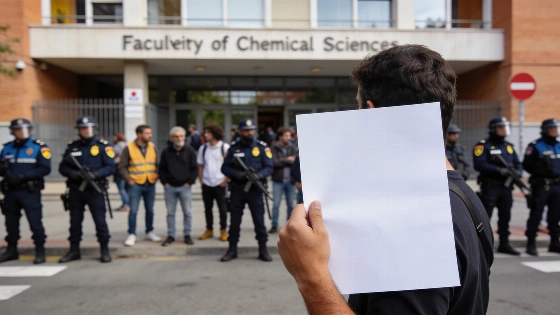
The dispute extended to universities. In early November, university staff joined colleagues teaching pupils from early-years through secondary school, along with vocational-training staff, in the open-ended strike. They called for more funding from the regional government. The account described the walkout as having lasted about a month in one passage and five weeks in another, so its duration is not consistent across the report. The strike began on 14 October and reached its one-month point on 14 November. By 13 November, the teachers’ strike committee had voted to continue the action and plan further mobilisations.
Beatriz García Osma, a professor at Universidad Carlos III de Madrid, posted two images on X showing collapsed ceiling material on desks and floors. She attributed the damage to what she called the regional government’s abandonment of public universities and warned that less visible consequences were worse.
Funding pressures also featured in the universities’ financial positions. Universidad Rey Juan Carlos was considering asking the regional government for a €40 million loan after years of underfunding. Complutense had requested a €34.5 million rescue package, citing its «deficitaria situación» and regional underfunding. The regional government, meanwhile, said the education stoppage had resulted in 395,000 lost teaching hours. Its planned minimum-service rules included one teacher per 70 students in Baccalaureate and coverage of up to 90% of class hours in subjects linked to the university entrance examination, PAU. The administration said the measures were intended to protect students’ preparation and evaluation through graduation; unions called the rules unconstitutional and said they would challenge them in court. The wider Madrid strike coverage included a separate strike report about a journalist covering a different stoppage.