Madrid’s regional government insists it has explained the secretive €6.3 million penthouse purchase. Key questions remain unanswered, fueling political tension and criticism from within the PP.
The Madrid regional government is under renewed pressure after Miguel Ángel García Martín, the councillor for Presidency, Justice and Local Administration, again defended the controversial acquisition of a €6.3 million penthouse by the public company Planifica Madrid. Despite repeated calls for transparency, the administration has not officially disclosed the purchase price or clarified whether the property was intended as an official residence for Isabel Díaz Ayuso, who authorized the deal, or what alternative options were considered.
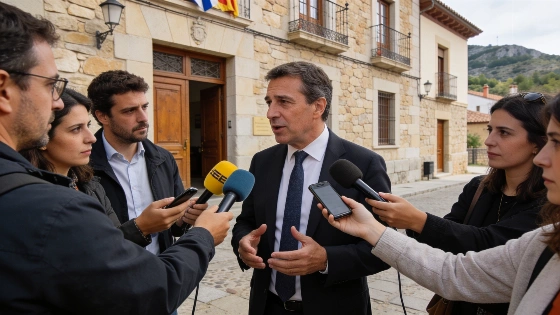
García Martín, designated by Ayuso to address the issue, reiterated during a public appearance in Patones that the property was acquired to serve the institutional needs of various regional ministries and to support Madrid’s official headquarters. However, the penthouse cannot be used as an office or as an official residence, raising further questions about the rationale behind the purchase. The councillor also attributed the subsequent decision to sell the property—along with four other units on Gran Vía—to shifting priorities following wildfires in the Sierra Oeste, stating that proceeds would be redirected to reconstruction efforts.
The sale was announced just one day after EL PAÍS revealed the secret purchase, which had taken place three months earlier without public disclosure. García Martín emphasized that the properties are now listed on official procurement and Planifica Madrid portals, open to any interested buyers. He dismissed the ongoing controversy as a political maneuver by left-wing parties to distract from national issues, a stance he has maintained in previous public statements.
The issue has drawn national attention, with even Alberto Núñez Feijóo, leader of the Partido Popular, expressing dissatisfaction with the explanations provided. Feijóo recently stated that the regional heritage department must clarify why a property unsuitable for office use was purchased, noting he had been aware since April of efforts to relocate Ayuso’s office and staff. Ayuso herself has avoided detailed responses, simply stating, “it’s for sale, chao ‘pescao.”
García Martín’s latest remarks came during the inauguration of a new municipal storage facility in Patones, a small town in Madrid’s Sierra Norte. The event, typically low-profile, attracted significant media attention due to the ongoing penthouse controversy. The councillor’s previous public appearance, nearly three weeks earlier, also failed to shed light on the decision-making process behind the purchase.
This episode highlights the growing demand for transparency in public spending and property acquisitions by regional governments in Spain. Similar scrutiny has been seen in other high-profile cases, such as the government’s response to the Ceuta migration crisis, where centralized management and emergency funding were introduced following public criticism, as detailed in coverage of the Ceuta crisis management shift. In the Madrid case, the lack of clear answers continues to fuel debate within the Partido Popular and beyond, underscoring the political risks of opaque decision-making in public administration.
For context, public property acquisitions in Spain are subject to strict procurement rules, but exceptions and discretionary decisions can occur, especially when justified as serving institutional needs. The controversy over the Madrid penthouse reflects broader concerns about accountability and the use of public funds, particularly when high-value assets are involved and transparency is lacking. As the property remains on the market, the outcome of the sale and any further disclosures from the regional government will be closely watched by both political opponents and the public.