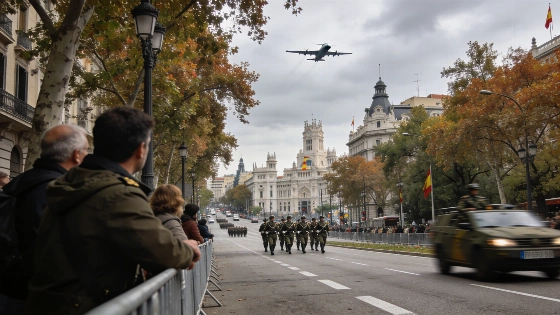
Madrid’s National Day parade will close central roads from 7.00 on Monday 12 October 2026. Transport diversions will continue into the evening, when Cibeles hosts a concert and fireworks.
By 7.00 on Monday, security teams will begin restricting access around Madrid’s parade route. The ceremony starts at 11.00, but the operation will run until about 15.00.
Thousands of spectators are expected along the route. The programme includes an aerial display, a ground parade and tributes to the flag and the fallen. Those formations will move through some of the capital’s busiest streets before the daytime programme ends.
The route starts at the Glorieta del Emperador Carlos V. It follows the Paseo del Prado to Plaza de Cibeles, then continues along Paseo de Recoletos before ending at Plaza de Colón. The Ayuntamiento estimates that about 80,000 people could attend. That figure is a forecast, not a final attendance count.
12 October 2026 falls on a Monday and is Spain’s national holiday. Madrid’s official programme also includes an evening concert and fireworks at Plaza de Cibeles at 21.30, extending the day’s activity beyond the parade itself.
For visitors and residents, mobility is the immediate concern. The Ayuntamiento’s official calendar confirms the national-holiday date and places the parade within a wider programme of Día de la Fiesta Nacional events across Madrid.
Road restrictions are planned from approximately 7.00 to 15.00 on Monday 12 October. They will affect the Glorieta del Emperador Carlos V and the Paseo del Prado. Plaza de Cánovas del Castillo, Plaza de Cibeles and Paseo de Recoletos will also be affected, along with Plaza de Colón and Plaza de la Lealtad. Nearby roads face restrictions as well. Sections of Antonio Maura, Ruiz de Alarcón, Felipe IV and Alfonso XII are included in the plan. The timetable is indicative because the security operation may require changes during the day.
Access around the route has already begun to change. Plaza de Cánovas del Castillo has faced closures since 6 October. Night-time restrictions have also been scheduled on the Paseo del Prado and surrounding streets for signage work and rehearsals. A separate Ayuntamiento notice confirms that traffic controls begin during the preparation phase, rather than being limited to the ceremony on 12 October.
Madrid’s official celebration is not confined to the parade corridor. The municipal programme includes cultural and folkloric activities in several districts, including events connected with Spanish-speaking countries, so transport demand may also be spread across other parts of the city. The evening programme around Cibeles creates a second potential concentration of visitors after the daytime ceremony.
Public transport will not operate normally through the affected area. The municipal plan lists 48 daytime EMT bus routes for diversions or other route changes between 7.00 and 15.00. Recoletos and Atocha are the nearest Cercanías stations. Metro provides additional options around the parade zone.
Seven BiciMAD stations will also remain closed during the same period. Several taxi ranks and tourist-bus parking reservations will be temporarily unavailable. The available official search materials confirm the restrictions and preparation works, but do not independently confirm the full list of 48 routes.
Pedestrians are directed towards Hermosilla and Goya. Serrano and Génova are also listed, as are Alcalá and Atocha. Access will depend on instructions from the security operation, so anyone planning to watch from the street should arrive early and expect entry points to change.
The ceremony forms part of Día de la Fiesta Nacional, held every 12 October under Law 18/1987. The day combines institutional events with military ceremonies and cultural activities across Spain. Madrid hosts the most visible public gathering.
The parade brings together units from the Ejército de Tierra and the Armada. The Ejército del Aire y del Espacio, the Guardia Civil and other security bodies will also take part.
The event’s military dimension was examined in an earlier report, but the immediate practical issue in Madrid is the scale of the access operation. The flag-lowering ceremony is scheduled for 13.30. The full programme is expected to end around 15.00.
Those staying away from the centre can follow official coverage announced by broadcasters and institutions. The Ministry of Defence maintains a dedicated 12 October page with institutional information. Telemadrid is due to begin its broadcast at 9.30. Televisión Española will offer a special programme from 10.00 on La 1 and Canal 24 horas. LA RAZÓN will also carry a live stream.
Driving through central Madrid will be difficult during the operation. Public transport is the practical alternative, although diversions and changing access points will add walking time. Crowds and possible restrictions may return around Cibeles for the concert and fireworks scheduled for 21.30.