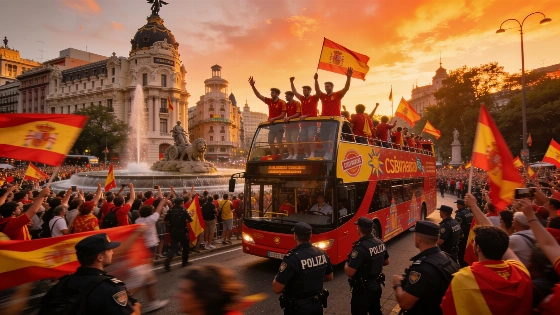
Madrid will see major road closures and reinforced public transport as La Roja celebrates its second World Cup title. Authorities expect over a million people in the city center. The main event will take place at Plaza de Cibeles.
Madrid is bracing for one of its largest public gatherings in recent years as La Roja marks its 2026 World Cup triumph with a citywide celebration. The municipality has rolled out an extensive security and mobility plan, anticipating more than a million people will flood the streets for the victory parade. The event, centered around Plaza de Cibeles, will bring significant changes to traffic and public transport across the capital.
The Spanish national team is scheduled to land at Barajas Airport around 12:50, before heading to official receptions at the Palacio de la Zarzuela and La Moncloa. After these formalities, the players will board an open-top bus for a parade through central Madrid, culminating at Cibeles. The route will take them from Moncloa through key arteries including Princesa, Alberto Aguilera, Carranza, Sagasta, Génova, Jorge Juan, Goya, Serrano, Plaza de la Independencia, Puerta de Alcalá, Alfonso XII, and Montalbán.
Authorities have already begun closing roads in anticipation of the crowds. Since midnight, progressive traffic restrictions have been enforced around Plaza de Cibeles, Paseo de Recoletos, and Paseo del Prado between Plaza de Neptuno and Cibeles. Additional closures affect Calle de Alcalá between Cibeles and Plaza de la Independencia, as well as Gran Vía between Alcalá and Hortaleza. The city warns that closures may expand to adjacent streets depending on crowd size, potentially impacting access to major parking facilities such as Serrano III, Sevilla, Recoletos, Las Cortes, and Plaza del Rey.
Security will be tight, with around 700 officers from the National Police and Guardia Civil, supported by 250 municipal police. The parade is expected to depart from the Moncloa Interchange between 19:30 and 20:00, with the main festivities at Cibeles running until 23:00. Organizers have hinted at special surprises during the event, which is forecast to draw unprecedented crowds.
Public transport will be reinforced to accommodate the influx. Metro lines 1, 2, 3, and 4 will operate with increased frequency until the end of service, and extra staff will be on hand at stations to assist travelers. For security reasons, Banco de España Metro station will be closed. Several EMT bus lines will be diverted, with details available on the EMT Madrid website. Night bus services will also be boosted, and multiple Bicimad bike stations in the area—including those at Cibeles, Recoletos, Colón, Marqués de la Ensenada, and Plaza de Margaret Thatcher—will be temporarily out of service. Taxi ranks on Paseo del Prado, Plaza de la Lealtad, Barquillo, Marqués de Casa Riera, and Clavel will also be affected.
The scale of the celebration recalls other major sporting events in Spain, and the city’s preparations reflect lessons learned from previous large gatherings. Notably, the involvement of the Royal Family and top government officials underscores the national significance of the occasion. For context, the presence of Spain’s royals at World Cup events has previously drawn public attention, as seen when a live TV broadcast was interrupted during a royal appearance at a World Cup final.
Madrid’s authorities urge residents and visitors to plan ahead, use public transport, and stay informed about real-time changes to mobility. The city’s approach aims to balance celebration with safety, as the capital becomes the epicenter of national pride for an evening.
Spain’s World Cup victory marks only the second time in history that La Roja has claimed the title, making this celebration a rare and highly anticipated event. The city’s infrastructure and emergency services will be under pressure, but officials express confidence in their ability to manage the crowds and ensure a memorable night for fans and residents alike.