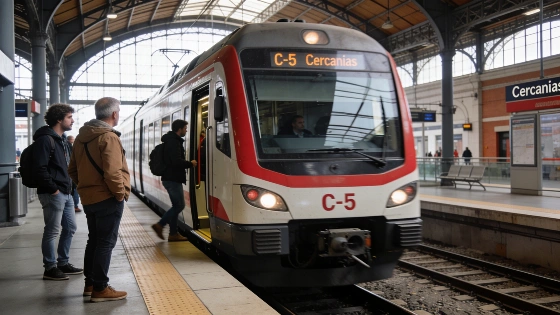
Madrid’s C-5 Cercanías line returns to normal on Monday after a month of closures. Metro Line 9B between Arganda del Rey and Rivas Vaciamadrid also reopens. Both projects aimed to modernize key infrastructure.
Madrid’s public transport network is set for a significant improvement as the C-5 Cercanías line (Humanes/Fuenlabrada–Móstoles El Soto) resumes full operations on Monday, August 16, following a month of service interruptions caused by extensive works at Atocha Cercanías station. The disruptions, which began on July 17, were part of a complex project to overhaul the station’s track layout, directly impacting thousands of daily commuters.
Since July 23, the C-5 line was split, with a complete suspension between Villaverde Alto and Embajadores. During this period, trains only ran between Humanes/Fuenlabrada and Villaverde Alto, and between Móstoles El Soto and Embajadores, with a reduced frequency of every 10 minutes. To bridge the gap, Renfe introduced shuttle trains from Villaverde Alto to Méndez Álvaro, stopping at Puente Alcocer, Orcasitas, and Doce de Octubre, operating every 35 minutes until Sunday.
Although regular service on the C-5 is set to return, the broader modernization project at Atocha will continue until August 28. Two additional weekend closures are planned for the Sol tunnel between Atocha and Nuevos Ministerios on August 29–30 and September 5–6, affecting C-3 and C-4 lines. Temporary terminus stations will be established at Atocha and Nuevos Ministerios for these lines during the works. The upgrades, concentrated in the summer to minimize disruption, represent the final phase of interventions in the Sol tunnel. The project, with an investment of nearly €56 million, will shift the station’s configuration from a 4+3+3 track scheme to a 4+4+2 layout, increasing Sol tunnel capacity by up to 33% from October and benefiting both C-3 and C-4 lines, as well as other routes passing through Atocha.
In parallel, Metro Madrid’s Line 9B (TFM) between Arganda del Rey and Rivas Vaciamadrid has fully reopened this Friday after being closed since July 25 for infrastructure renewal. The works focused on upgrading track superstructure and replacing expansion devices to enhance reliability and safety. The reopening restores a key suburban connection for southeast Madrid.
Elsewhere in the metro network, improvement projects continue. Line 7 remains closed between Gregorio Marañón and Pitis until August 28, while Line 6 is suspended between Argüelles and Ciudad Universitaria until September 2 due to works at Moncloa station. Additionally, Cuzco station on Line 10 is closed for renovations until the end of August, with further works on Line 10 expected to last through the year.
These upgrades are part of a broader push to modernize Madrid’s transport infrastructure, aiming to reduce future disruptions and improve capacity. The timing of the works during the summer, when passenger numbers are lower, is intended to limit inconvenience. Similar strategies have been used in other regions, as seen when emergency services responded to severe storms in southern Valencia, which also led to temporary transport disruptions, according to recent reports on weather-related incidents.
Madrid’s ongoing investment in its rail and metro systems reflects the city’s commitment to maintaining efficient, safe, and modern public transport. The phased approach to closures and upgrades is designed to balance the need for essential works with the daily mobility needs of residents and commuters. As the final stages of these projects conclude, passengers can expect more reliable service and increased capacity on some of the capital’s busiest lines.